
Meta Launches Muse Wonder Models for Agentic Work
Meta launches Muse Wonder and Wonder Full with Active Memory and Active Focus to help AI agents remember context, recover from errors and complete complex tasks.
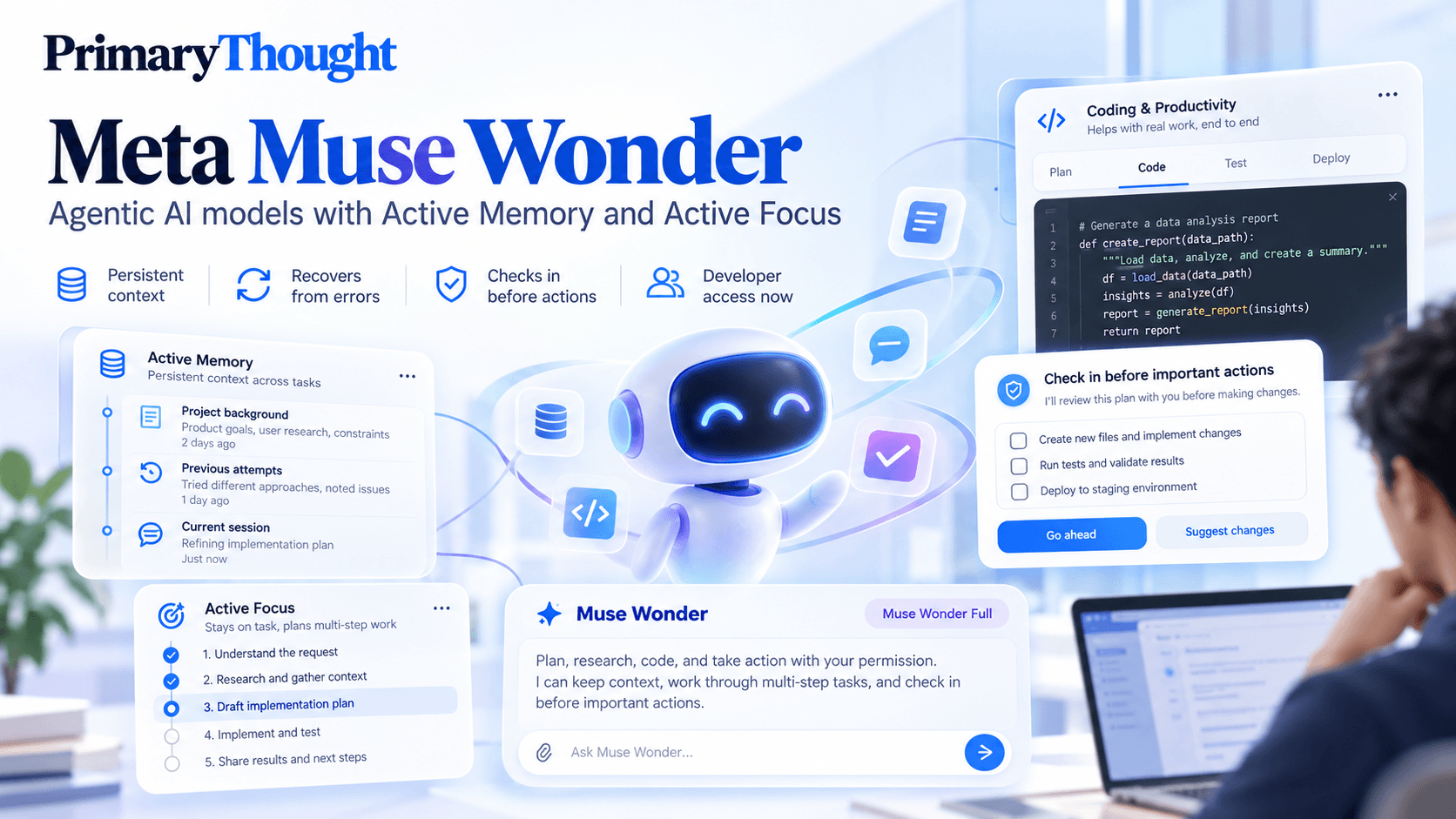
Meta has released two new models, Muse Wonder and Muse Wonder Full, and is pitching them squarely at agentic work: long-running tasks in which a model plans, acts, recovers from mistakes and checks back with a person. The launch, announced on October 12, matters because it is Meta's clearest statement yet that it wants to compete in the market for agent-grade models, and because the two features it leads with, Active Memory and Active Focus, speak directly to the problems that have limited agents in practice.
What Meta announced
According to Meta's announcement, Muse Wonder and Muse Wonder Full are the company's "most capable models to date", built on the groundwork laid by its earlier Muse Spark model. Meta says they deliver state-of-the-art results on personal and professional agentic tasks, with examples that include handling an insurance claim, making sense of a lease and building a working application. The company also points to expert domains such as law, finance and health, alongside frontier-level coding.
Availability is split by audience. Muse Wonder is available now to developers and builders through the Meta Model API and through Muse Code. Muse Wonder Full is available to Muse Code subscribers. Meta adds that Muse Wonder will soon power more experiences inside Muse, its assistant product, rolling out to subscribers first. A summary from Let's Data Science notes that Meta has not published a broader rollout schedule beyond that, and that neither source gives pricing for the models or for Muse Code subscriptions.
Notably, the announcement page contains no benchmark numbers. Meta refers readers to its research blog for details, so the performance claims are, for now, the company's own assertions rather than figures anyone outside Meta has reproduced.
Active Memory and Active Focus
The two named features are the most concrete technical signal in the launch. Meta describes Active Memory as the ability to carry relevant context across conversations and to bring back details that matter for the task at hand. For an agent that is meant to handle something as drawn-out as an insurance claim, persistent context is not a luxury: without it, each session starts from scratch and the user has to restate the situation.
Active Focus addresses a different weakness. Meta says the model keeps working toward a goal when a task becomes difficult, tries alternative approaches, recovers from errors, asks for clarification when it needs to, and checks in before important actions. That last behaviour is the one with the largest practical consequence. Agents that can take real actions, such as sending messages or changing records, are only useful if they pause at the right moments. A model that over-asks becomes tedious; one that under-asks can do damage.
Both descriptions are behavioural claims. Meta has not, in the material reviewed here, explained how memory is stored or how a user can inspect, edit or delete what the model remembers, and it has not said how the check-in behaviour is tuned. Let's Data Science flags exactly this gap, describing as an open question how Meta will implement its memory and approval controls for agents that handle sensitive personal data.
Safety and the open questions
Meta says the models are trained to avoid sharing private information without permission and to decline requests to help with harmful acts. It also says it is working to improve defenses against cyberattacks while keeping the models useful for defensive work, such as finding flaws in a developer's own code. Development and release follow what the company calls its Superintelligence Scaling Framework, and a fuller report with additional safety evaluations is promised "soon".
That safety report is worth watching. A model that remembers past conversations and can take actions creates greater privacy risks if something goes wrong. It has more information that could be exposed and more opportunities to make mistakes than a chatbot that does not retain context. Until Meta publishes the safety report, its claims about protecting private information and refusing harmful requests remain training goals, not proven results.
What is confirmed and what is not
Confirmed by Meta's own announcement: the two model names, the October 12 date, the access routes for developers and subscribers, the two headline features, and the existence of a forthcoming safety report. Not established by any source opened for this article: how the models rank against rivals, what they cost, how large their context windows are, and how well the memory and check-in features work outside Meta's chosen examples.
Why it matters for the agent market
Agent platforms are increasingly differentiated less by raw model quality than by how reliably a model finishes multi-step work without supervision. Vendors have converged on a similar pitch: models that plan, use tools, remember context and know when to stop and ask. By framing Wonder around those behaviours, rather than around a single headline benchmark, Meta is competing on the terrain where buyers now evaluate.
The product structure is also revealing. Putting the more capable Wonder Full behind a Muse Code subscription, while offering Wonder through the Meta Model API, suggests Meta is testing two routes at once: a developer platform where other companies build on its models, and a first-party subscription product where it controls the experience. Which route gains traction will shape how much of Meta's agent work is open to outside builders.
There is also a competitive context. A launch that emphasises coding and professional tasks puts it in direct comparison with the established agentic coding tools. Developers will judge the models on whether they hold up over long sessions, not on the launch language, and independent testing is the step that will settle that.
What to watch next
Several things will determine whether Wonder becomes a serious option for agent builders. The first is the research blog and safety report Meta has promised, which should supply the benchmark numbers and evaluations that are currently absent. The second is pricing and rate limits on the Meta Model API, which will decide whether developers can afford to run long agent loops on it. The third is independent evaluation: third-party testers will probe how reliably the models recover from errors and whether Active Focus asks for confirmation at sensible points rather than too often or too rarely.
Finally, the Muse rollout matters for ordinary users. When Wonder starts powering the Muse assistant, the memory feature will meet real personal data at scale, and the controls Meta provides for viewing and deleting that memory will be an early test of how seriously the company treats the privacy implications of an agent that remembers.
For now, the accurate summary is narrow: Meta has shipped two new agent-oriented models, made one broadly available to developers, and described two features that target real agent failure modes. Whether they perform as described is still to be shown.
Frequently Asked Questions
What are Muse Wonder and Muse Wonder Full?
They are two models Meta announced on October 12, 2026, which it calls its most capable to date, aimed at personal and professional agentic tasks.
Who can use them?
Muse Wonder is available to developers through the Meta Model API and Muse Code. Muse Wonder Full is available to Muse Code subscribers.
What are Active Memory and Active Focus?
Meta says Active Memory carries relevant context across conversations, while Active Focus keeps the model working through hard tasks, recovering from errors and checking in before important actions.
Are there independent benchmarks?
Not in the sources reviewed. Meta's announcement gives no benchmark numbers and promises a fuller safety report soon.