
VISION 2026: AI Agents Start Writing Machine Vision Apps
At VISION 2026, MVTec showed a prototype where AI agents build inspection apps from prompts, as the VDMA forecasts about 3% growth for Europe's machine vision market.
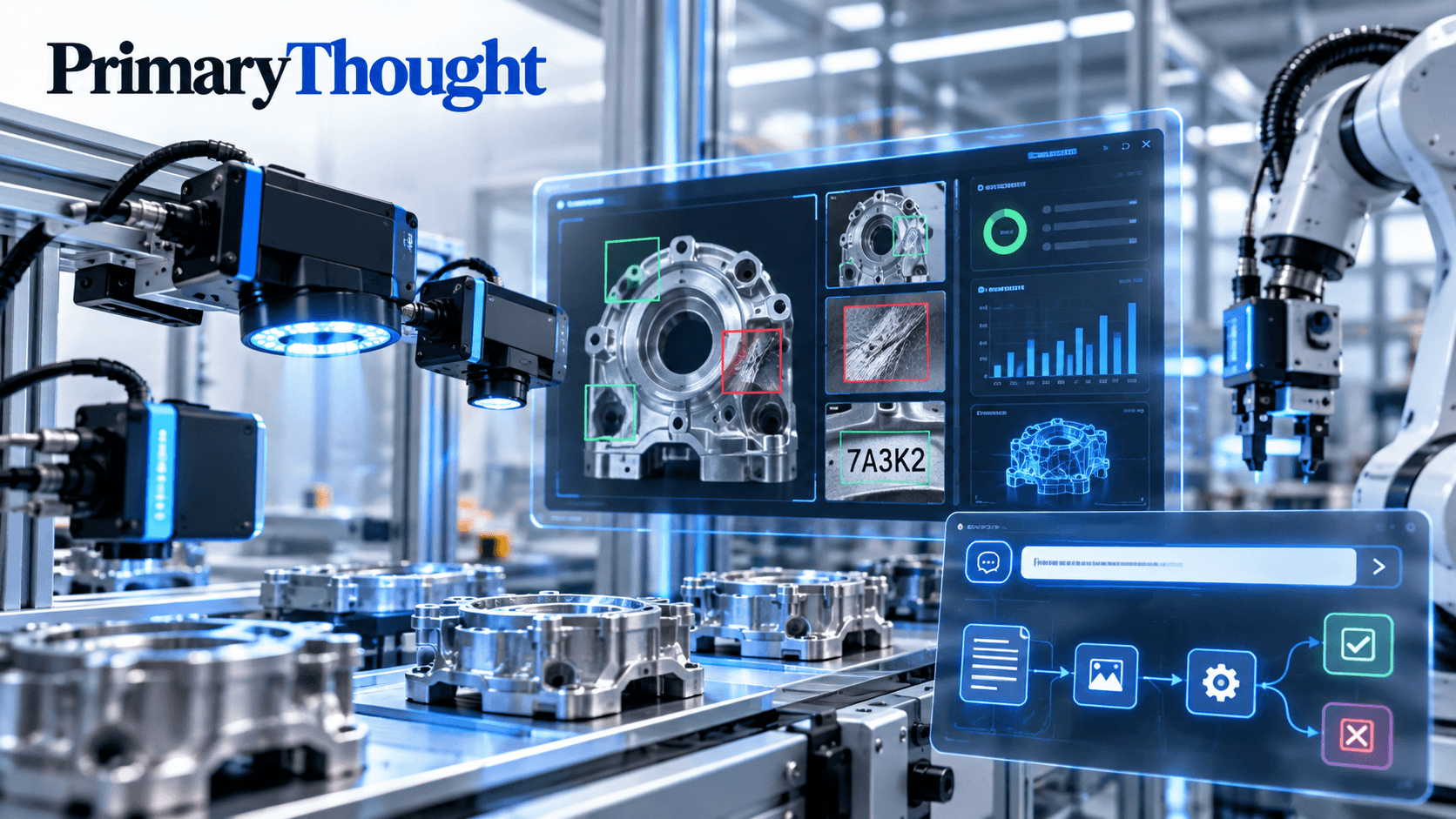
At VISION 2026 in Stuttgart this week, the most telling theme in industrial computer vision was not a new camera but a change in who builds vision systems. Software makers showed AI agents that generate inspection applications from plain-language descriptions, and an industry body reported that nearly two-thirds of surveyed companies see AI as central to their strategy. Together they suggest machine vision, long the domain of specialist integrators, is being reshaped by the same automation wave hitting software development.
A market returning to modest growth
The show, held at Messe Stuttgart from October 6 to 8 with about 500 exhibitors, opened with a market update. According to Vision Systems Design, the VDMA expects Europe's machine vision market to grow about 3% in 2026, a return to growth after a difficult stretch. Anne Wendel, the VDMA's director of machine vision, confirmed the forecast at the opening ceremony. Suppliers of cameras, sensors, optics and edge computing platforms grew about 4% in 2025, and the report says momentum is expected to continue, while the systems segment is still recovering, particularly in Germany where demand has lagged.
Those are modest numbers, and they matter as context. The AI story at VISION is unfolding in a market that is stabilising rather than booming, which makes efficiency gains in building and deploying systems more attractive to buyers and vendors alike.
Agents that write vision applications
The clearest example came from MVTec, maker of the HALCON library. As described in Robotics Tomorrow's account of the company's announcement, the "AI Vision Solver" is a prototype that pairs HALCON with AI agents. A developer describes a task in natural language and with images; the agents interpret the request, build an image-processing workflow, pick operators from the HALCON library and generate an executable application. They draw on a knowledge base MVTec predefines, and when generated code has syntax errors or logical gaps, that information is fed back so the agents can refine their output iteratively.
At the booth, visitors could select tasks such as barcode reading, matching or OCR on a touchscreen and implement them through prompts, according to the same account. MVTec says the developer's role shifts from programming individual steps to defining, evaluating and optimising the overall application. Dr. Maximilian Lückenhaus, the company's director of marketing and business development, is quoted as stressing that "AI does not assume full responsibility for the industrial application."
Two caveats apply. First, the Solver is a prototype, and the source gives no release date or commercial availability. Second, the underlying environment, HDevelopEVO, is a next-generation development environment that MVTec says will gradually replace the current HALCON IDE starting in 2027. How well the agent approach performs on real production tasks has not been shown publicly; the demonstrations described are simple, well-known tasks.
A preview of exhibitors adds that MVTec's HALCON 26.11 is due on November 18, 2026, adding oriented bounding boxes, per-class confidence thresholds and an ONNX Runtime interface for 64-bit Arm Linux, with MERLIC 26.10 due on October 15. Those are planned releases according to the preview, not shipping products.
Smarter cameras, not just smarter software
The same preview shows how much AI is moving onto the device. It lists Zebra's NS42 AI sensor, which runs deep-learning classification, segmentation, anomaly detection and OCR on an onboard NPU, and Baumer's VeriSens VS200, which it says handles up to 40 inspections per second with local processing. IDS is showing cameras that run neural networks on the camera itself, and Allied Vision a short-wave infrared camera paired with an NVIDIA Jetson Orin. Basler is showing AI-based OCR and barcode reading combined with dimensioning of moving objects, plus an agentic engineering concept the preview explicitly says is not a released product. All of these descriptions come from the preview's summary of exhibitor plans rather than independent testing.
The direction is consistent: classification and anomaly detection that once needed a separate industrial PC are being pushed into the sensor, which lowers integration effort and latency and fits the move towards simpler, more repeatable deployments.
Why it matters: who builds the system
Vision Systems Design reports that nearly two-thirds of surveyed companies named AI as central to their business strategy, and that AI is enabling new deployment methods and customisation rather than simply improving established applications. It also notes a shift in Germany in particular: some companies that once hired integrators for full-function, closed products are now hiring data scientists to build their own vision solutions. The article raises, without answering, what that means for integrators and solution providers, and says the VDMA briefing did not directly address the point.
That is the real tension. Tools that turn a prompt into a working inspection routine lower the skill needed to build one, which could accelerate the in-house trend. But MVTec's own message that human judgement stays essential is a reminder that validation, safety and process responsibility do not disappear. Integrators who sell that responsibility may be better placed than those who sell only configuration.
Other signals from the show
A separate IMV Europe preview points to a wider set of themes: Fraunhofer IPA's Dr Werner Kraus opening with a keynote on humanoid robotics and a panel asking "Will Humanoids kill traditional Machine Vision Systems?"; semiconductor inspection, where it says Teledyne DALSA and Allied Vision both present 32K line-scan imaging for wafer inspection; and hyperspectral imaging, with Research and Markets forecasting growth from $832.1 million in 2026 to about $3.30 billion by 2036. The preview also reports about 136 speakers across the three days. These items are drawn from a pre-show guide, so they describe the programme rather than outcomes.
What to watch next
- From prototype to product. Whether MVTec announces availability for the AI Vision Solver, and how it handles validation of generated applications.
- Competing approaches. Whether other vision-software vendors follow with their own agent-based development tools, and whether they ship them in released products rather than concept demos.
- Integrator response. Evidence on whether in-house vision teams are growing and how integrators reposition.
- Recovery data. Whether the VDMA's roughly 3% growth forecast holds, particularly for systems demand in Germany.
The takeaway is measured: VISION 2026 showed prototypes and plans more than proven results, but the direction of travel is clear. AI is moving into both the camera and the toolchain, and the people deciding how vision systems get built may soon look different.
Frequently Asked Questions
What is MVTec's AI Vision Solver?
A prototype combining HALCON with AI agents that turn natural-language and image descriptions into executable machine vision applications. No release date has been given.
What is the outlook for Europe's machine vision market?
The VDMA expects about 3% growth in 2026, after components suppliers grew about 4% in 2025.
How important is AI to vision companies?
Per Vision Systems Design, nearly two-thirds of surveyed companies named AI as central to their business strategy.
Why does this matter for integrators?
Some firms, especially in Germany, are hiring data scientists to build vision solutions in-house rather than buying closed products, though the sources do not say how integrators will respond.