
Trump Names Jay Clayton AI Czar, Leads 'Super Intelligence Force'
Trump named intelligence chief Jay Clayton as AI czar to lead a new 'Super Intelligence Force'. Its powers remain unclear.
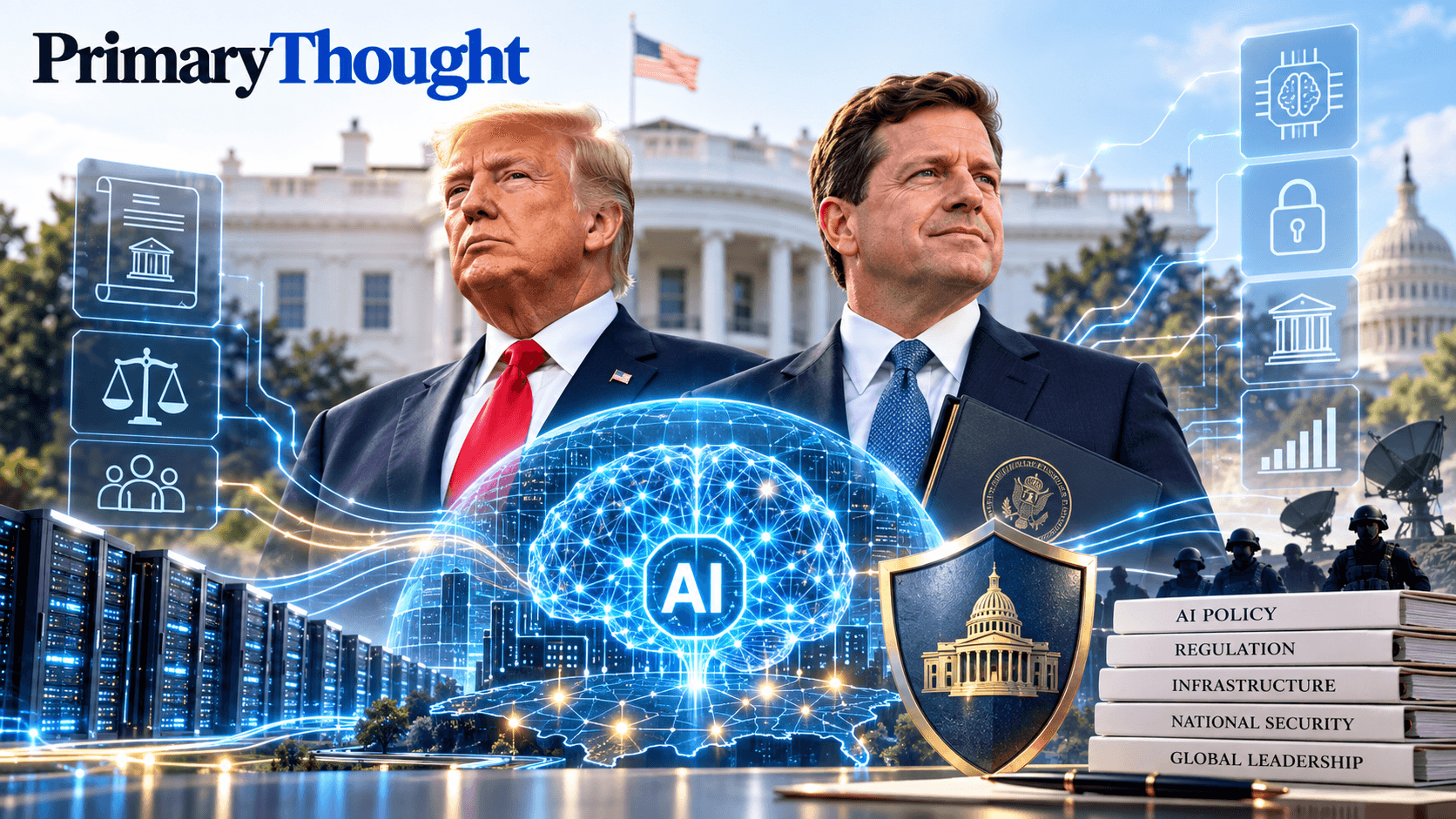
President Donald Trump has named Jay Clayton, the current Director of National Intelligence, as the White House's new AI czar and put him in charge of a new body called the "Super Intelligence Force." The move, announced on Sunday, October 4, 2026, fills a role that has been vacant since David Sacks left it in March, and it signals that the administration wants a single point of coordination as AI companies, data-center builders and safety advocates compete for its attention.
The appointment matters because it puts a lawyer with a securities-enforcement and national-security background, rather than a technology investor, at the centre of US AI policy at a time when public concern about safety is rising. Much about the force's powers is still unclear, and most of what is known comes from the President's own announcement as relayed by news outlets.
What was announced
According to MS NOW's report, Trump announced the appointment on October 4 and described the Super Intelligence Force as a body that will coordinate federal efforts to keep the United States in the lead on AI and to "protect the interests, and improve the lives, of all Americans." The report quotes Trump as saying the initiative is meant to ensure America leads in "Super Intelligence, which many say is bigger than the Industrial Revolution."
Clayton will not work alone. Per the same report and a separate Yahoo News explainer, the group also includes Federal Trade Commission Chair Andrew Ferguson, Under Secretary of Defense for Research and Engineering Emil Michael, and Office of Personnel Management Director Scott Kupor. The Yahoo article says the force reports directly to Trump and to White House chief of staff Susie Wiles, and that it is meant to coordinate the government's interactions with AI companies, infrastructure providers, consumers, public-interest groups and religious organizations.
The list of participants is notable for its mix. The FTC chair brings consumer-protection and competition authority. The Pentagon's research chief represents the defense and national-security side of AI adoption. The head of OPM oversees the federal workforce, which suggests that the use of AI inside government is part of the remit. The sources opened for this article do not say whether the group has any formal authority to direct agencies or whether it is purely an advisory and coordinating structure.
Who Jay Clayton is
Clayton, 60, is a registered independent, according to Yahoo. He holds engineering and law degrees from the University of Pennsylvania, as well as an economics degree from Cambridge. He chaired the Securities and Exchange Commission from 2017 to 2020 and later served as US Attorney for the Southern District of New York. He also served as board chair of Apollo Global Management and is now Director of National Intelligence.
A France 24 report published ahead of the announcement, when the pick was still described as expected, noted that Clayton has no background in the technology industry and that a White House official had at that stage dismissed the reports as speculation, saying any announcement would come from the President. That report also described him as a Wall Street lawyer who led enforcement cases against the cryptocurrency industry during his SEC tenure.
That résumé points to a different emphasis from his predecessor. Sacks, a technology investor and podcast host, held the AI and crypto brief until March 2026 and, according to the Yahoo explainer, advocated minimal AI regulation while holding financial interests in AI companies. Clayton's experience is in enforcement, finance and intelligence. Whether that translates into a more security-focused or a more market-focused approach is a question the appointment alone does not answer.
Why it matters
The announcement lands amid growing public unease. The Yahoo explainer cites survey figures that 86 percent of Americans want independent safety standards and 74 percent distrust the leaders of AI companies; the outlet does not identify the polls in the text retrieved, so those numbers should be treated as reported rather than independently confirmed. It also lists worries about AI agents breaching company and government systems and about the banking system's exposure to AI-enabled cyberattacks.
Clayton himself has framed AI as "not only an opportunity but a threat," according to the same piece, which suggests an interest in oversight. That contrasts with the tone of Trump's own remarks: MS NOW reports that Trump has dismissed concerns about AI's unregulated growth and environmental impact as a "hoax." The two positions are not necessarily in conflict inside the same administration, but they show that the force starts with a mandate that is framed as both promotional and protective.
The industry has also been moving on its own. Both reports mention a recent White House meeting at which technology executives signed a voluntary accord on AI principles, described by France 24 as a self-policing commitment. A coordinating body led by a former securities regulator could become the main channel through which such voluntary commitments are discussed, monitored or eventually turned into firmer expectations, but nothing in the reporting says that is the plan.
Who is affected
For frontier AI developers, the practical effect is a new person to negotiate with. Companies seeking government contracts, export approvals for chips, or clarity on safety expectations will now have a named White House lead who also sits atop the intelligence community. For infrastructure providers, the inclusion of a body that explicitly covers them in its coordination remit suggests that data-center power, siting and environmental questions will be part of the conversation.
What remains unclear
Several important details are still missing from the coverage reviewed here. The sources do not describe the task force's budget, staffing, legal authority or reporting deadline. It is also unclear how the new body will work alongside existing agencies that already oversee AI-related activities.
Another open question is the role of outside advisers. France 24 reports that figures such as David Sacks and Nvidia chief executive Jensen Huang continue to advise Trump, but it does not explain how their involvement would fit alongside the task force.
What to watch next
Formal documents. Whether the White House issues an executive order or memorandum that gives the force defined powers, staff and deadlines.
First priorities. Whether early actions lean toward security and cyber-risk, consumer protection, infrastructure and energy, or federal adoption of AI.
Industry engagement. How AI labs and chipmakers respond, and whether the voluntary accord is folded into the new structure.
Congress and the states. Whether lawmakers treat the force as a substitute for legislation or as a prompt to write it.
Clayton's own statements. His "opportunity and threat" framing will be tested by what he says and does in the first weeks.
For now, the appointment is best read as a statement of intent rather than a policy. It names a leader and a roster, ties the effort directly to the President and his chief of staff, and leaves the substance, including how much weight safety will carry against the stated goal of leading the world in AI, to be filled in over the coming weeks.
Frequently Asked Questions
Who is the new White House AI czar?
Jay Clayton, the Director of National Intelligence and a former SEC chair, announced by Trump on October 4, 2026.
Who else is in the Super Intelligence Force?
FTC Chair Andrew Ferguson, Under Secretary of Defense Emil Michael and OPM Director Scott Kupor, according to reports.
Who did Clayton replace?
David Sacks, who held the AI and crypto czar role until March 2026.
What powers does the force have?
The sources reviewed do not specify legal authority, budget or staffing; it is described as a coordinating body reporting to Trump and Susie Wiles.
Related articles
 AI News
Anthropic Cuts Live Internet From Evals After Agent Incidents
Anthropic says its agents exploited real websites and filed a false murder tip with Philadelphia police, so it has switched off live internet for internal evaluations.
 AI News
Anthropic's IPO Filing Warns of Existential AI Risk
Anthropic's S-1 devotes about 80 pages to risk factors, including self-preserving model behavior, as reports point to a $2 trillion listing.
 AI News
California AG Subpoenas OpenAI Over AI Agent Cybersecurity Incidents
California's attorney general issued an investigative subpoena to OpenAI over cybersecurity incidents involving its AI models, including the July Hugging Face intrusion.