
Ataraxos Beats Stratego’s Top Player Using Far Less Compute
A system developed by researchers at CMU, MIT, NYU and Stanford beat Stratego’s top player 15-1-4, while the authors say it required only a fraction of DeepNash’s training effort.
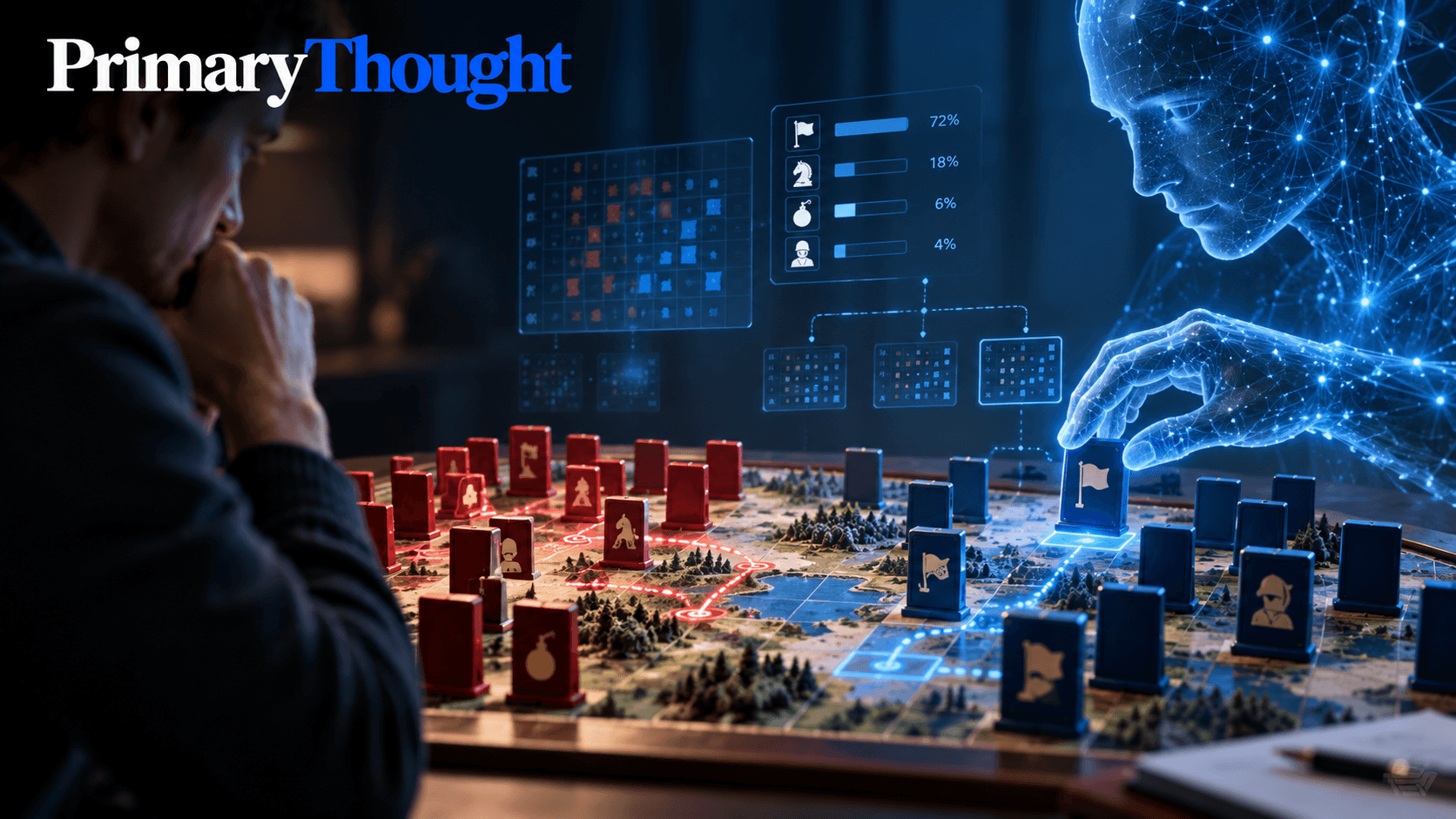
A team of researchers from Carnegie Mellon University, MIT, NYU and Stanford has built a Stratego-playing system called Ataraxos that defeated the game's most successful player in an official 20-game series, according to a Nature paper and an MIT announcement published on September 30. The result is notable not just because of the win, but because of how the system was trained. The researchers say Ataraxos reached this level using only a small fraction of the training effort DeepMind used for its earlier DeepNash system. They also report that the same approach can be applied to other games that involve hidden information.
What happened
According to MIT News, Ataraxos defeated the world's strongest Stratego player 15-1-4. The Decoder identifies the player as Pim Niemeijer, a four-time world champion, and reports that the series took place over three weeks, giving Niemeijer time to rest and prepare between games. If draws are counted as half a win, The Decoder calculates Ataraxos's effective win rate at 85%.
The two sources differ on one detail. MIT reports a 39-2 record against top players at the world championship, while The Decoder reports 38 wins in 40 exhibition games at the 2025 championship. Both accounts point to a dominant performance, but the exact tally should be verified against the Nature paper.
MIT lists Samuel Sokota of Carnegie Mellon University as the lead author and Gabriele Farina of MIT as the senior author. The co-authors include Eugene Vinitsky, Zico Kolter, Hengyuan Hu and Zhiyuan Fan.
Why Stratego is hard
Stratego hides each player's piece identities from the opponent, so a player must reason across a huge number of possible positions. The Decoder cites roughly \(10^{33}\) possible piece setups. MIT quotes Farina as saying there is "an explosion of possible universes" and that techniques used in poker could not scale to the game. Poker-based methods work by reasoning over everything the opponent might hold, but that approach becomes impractical when the hidden state is this large.
DeepMind's DeepNash was the previous major milestone. The Decoder reports that it trained for two to three months on 1,024 TPU nodes, at an estimated cost of $3 million to $4.5 million. It won 19 of 28 games at the 2023 championship, while also losing to top players including Niemeijer. That cost figure is The Decoder's estimate rather than a number published by DeepMind.
How Ataraxos works
MIT describes Ataraxos as having two main components. The first is self-play reinforcement learning, which produces a blueprint strategy. The second is decision-time planning, where a generative model estimates the likely identities of the opponent's pieces before the system chooses a move.
The Decoder adds more detail. It says Ataraxos learns entirely through self-play, without using human game data. Early in training, strong regularization pushes the system to vary its setups and moves instead of settling too quickly on a single strategy. That pressure is then reduced in stages, allowing the system to move toward more deliberate play and make finer adjustments.
Before each move, a belief network estimates where the opponent's pieces are likely to be and samples a number of possible game states. Ataraxos then searches across those samples before deciding what to do. The Decoder says this kind of decision-specific search was largely avoided in earlier work because it was considered too difficult.
The overall idea combines a learned strategy with planning at the moment of play. That is similar in spirit to methods used in perfect-information games, but Ataraxos adapts the approach to hidden-information settings by using its belief model to estimate what it cannot directly observe.
Efficiency claims
The efficiency numbers are one of the paper's main findings. MIT says Ataraxos used less than one hundredth of the training examples and less than one thirtieth of the self-play games required by DeepNash, while still achieving higher playing strength. The Decoder reports that training took one week on 16 Nvidia H100 GPUs, followed by four days on four GPUs to train the belief network. It estimates the total cost at under $8,000 at 2025 prices and describes this as roughly one five-hundredth of the compute cost of DeepMind's approach.
There is an important caveat. The Decoder notes that the two systems have never been tested directly against each other because DeepMind said its code no longer works. The comparison therefore relies on each system's performance against human players and on their reported training budgets, rather than on a controlled head-to-head match.
Beyond one game
MIT says the method also achieved superhuman performance in Barrage Stratego, Hanabi and Dou Dizhu. That broader performance suggests the approach is not limited to a single game. The Decoder quotes the researchers as arguing that large amounts of hidden information are no longer a fundamental obstacle for reinforcement learning and search.
The authors point to possible applications in other hidden-information problems, including negotiation, security and military strategy. MIT specifically lists military strategy, business negotiations and cybersecurity as potential uses. The Decoder, however, highlights an important limitation: the approach assumes that fast simulators are available. Real-world negotiations and markets do not offer the same kind of cheap, repeatable simulation, so those applications remain speculative rather than demonstrated.
Limitations
The Decoder highlights two main limitations. First, the search procedure effectively mimics only a single learning step. That means giving the system more computing power during play does not necessarily make it stronger, although the researchers suggest that more sophisticated search methods could improve this.
Second, Ataraxos did not adapt its strategy across games in the series. Niemeijer, by contrast, could adjust his play from one game to the next. One three-time world champion described that difference as a major handicap for the AI. Players also said Ataraxos had an unpredictable style, including bluffs that human players would usually consider too risky.
MIT says the researchers plan to focus on interpretability in future work so people can better audit the system's decisions. That reflects another challenge: a strategy learned through self-play can be difficult to inspect and explain.
Why the cost matters
If the reported budget holds, the bigger practical question is who can afford to do this kind of research. A system trained for under $8,000 on a relatively small number of GPUs could potentially be reproduced by a university lab, while a multi-million-dollar TPU run would be far harder to replicate outside a large company.
That is an analysis of the cost difference rather than a finding from the paper itself, but it helps explain why the training budget drew almost as much attention as the match result. It also makes independent replication more realistic for outside research groups, which will be important for testing how well the method holds up beyond the original team.
The Next Test for Ataraxos
Three things will be worth watching. First, independent replication will show whether the reported cost and sample-efficiency gains hold up outside the authors' own setup. Second, adding test-time scaling to the search process would test one of the system's stated limitations. Third, applying the method to settings without a fast simulator will show whether its advantages in hidden-information problems extend beyond board and card games.
For now, the demonstrated result is narrower but still significant: a relatively modest-budget system defeated the strongest human player in a game that had resisted earlier methods.
Frequently Asked Questions
What is Ataraxos?
An AI system for Stratego built by researchers from Carnegie Mellon, MIT, NYU and Stanford. It combines self-play reinforcement learning with decision-time planning that uses a generative model of the opponent's hidden pieces.
How did it do against humans?
MIT News reports it beat the world's strongest Stratego player 15-1-4 in an official series. The two sources differ slightly on its exhibition record against other top players.
How does it compare with DeepMind's DeepNash?
MIT says it used under one hundredth of the training examples and under one thirtieth of the self-play games. No direct head-to-head match exists, because DeepMind's code reportedly no longer works.
What are its limitations?
According to The Decoder, extra compute at play time does not improve its search, it did not adapt across games like the human player, and real-world applications would need fast simulators.
Related articles
 Algorithms & Research
Context Language Models: A New Way for LLMs to Manage Their Context
A UW and Meta paper has models manage context as an editable file, reporting higher accuracy at lower compute on long agent tasks. The results are self-reported.
 Algorithms & Research
Google DeepMind Launches Institute for Open Debate on AGI Timelines and Safety
The new DeepMind Institute, led by figures including Demis Hassabis and Shane Legg, is publishing essays that do not always agree, aiming to widen the debate over how close AGI is and how it should be governed
 Algorithms & Research
Anthropic Says Claude Agents Discovered a Novel CRISPR-Like Enzyme System in Bacteriophage Genomes
A swarm of 950 Claude agents screened 200,000 reverse transcriptases and identified a previously uncharacterized enzyme system, an early result from Anthropic's new life sciences research group.