
GSA Strikes Usage-Based ChatGPT Deal for Governments
GSA's new OneGov agreement gives federal, state, local and tribal governments half-price token usage on ChatGPT models with no platform fee or minimum spend.
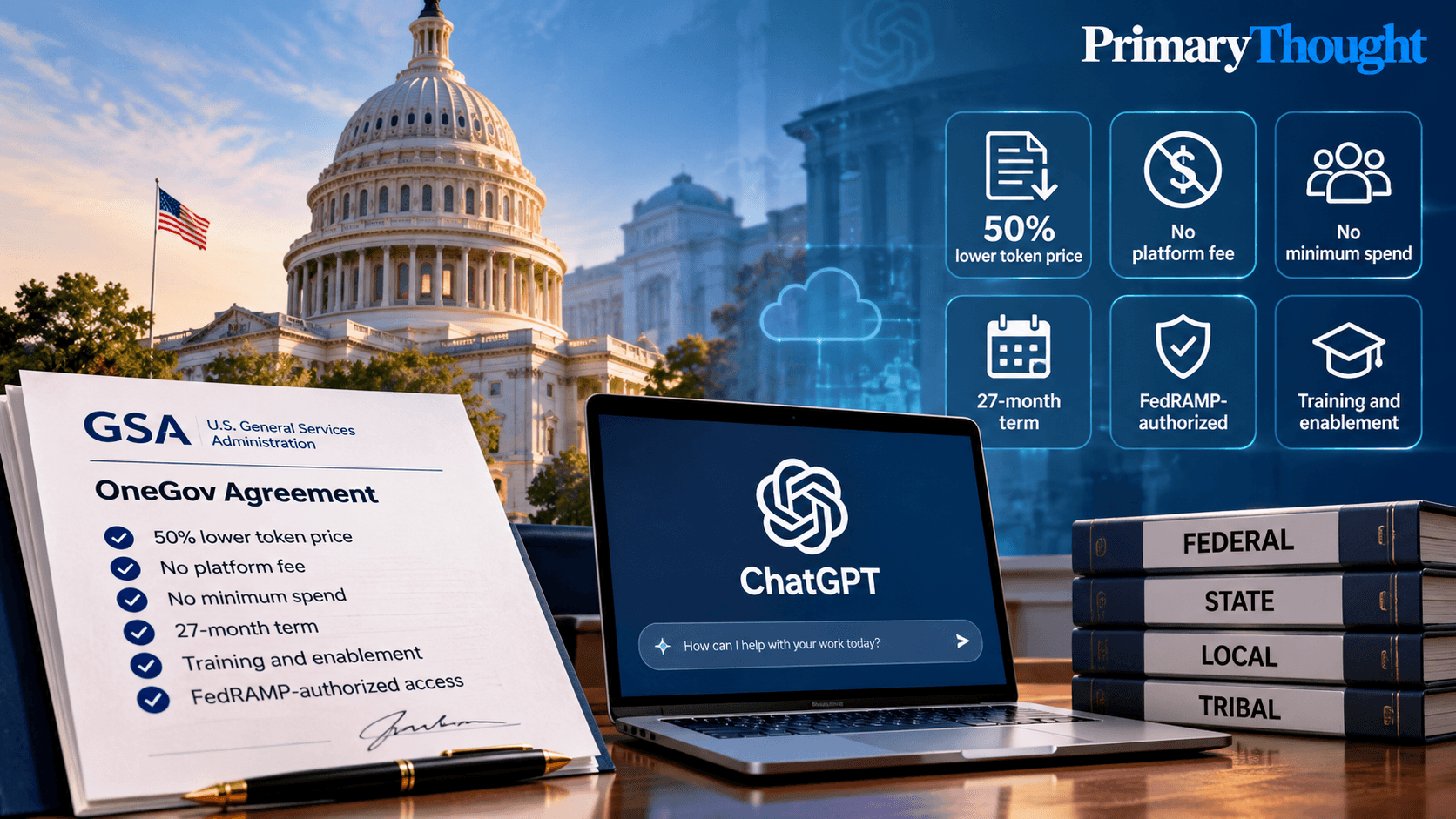
The US General Services Administration has replaced the nominal-price era of federal ChatGPT access with a usage-based one. Under a new OneGov agreement announced on September 10, 2026, agencies can buy OpenAI's models at half the token price, with no platform fee and no minimum spend, starting October 1. It is the first deal under the next phase of GSA's OneGov AI strategy, and it changes how governments at every level budget for generative AI.
What the agreement contains
According to GSA's announcement, the offer runs for 27 months and gives a 50 percent discount on token-based usage across ChatGPT models, including those in FedRAMP-authorized environments. There is no platform-access fee, no minimum order, and no spend commitment, so an agency pays only for what it uses. The package also includes training and enablement resources and GSA's AI terms and conditions, which are intended to safeguard government data.
FedScoop reports that the agreement runs through December 31, 2028, and that it takes effect after the current $1-per-agency deal ends at the end of September. FedScoop also reports a separate OpenAI statement that the company is waiving its $15 per-user monthly licence fee, and that agencies get half-price access to some of OpenAI's cybersecurity platform, Daybreak, though the article does not specify the scope of that access. It gives no dollar figures for the underlying token rates, so the real cost per task remains unpublished in the sources reviewed here.
Who can use it
GSA says the offer is available to the executive, legislative, and judicial branches of the federal government and also to state, local, and tribal governments. Agencies can buy directly from OpenAI, through resellers or through supported cloud marketplaces, and can procure through GSA's Multiple Award Schedule once the offer takes effect.
The reach is the notable part. OpenAI says more than one million government employees already have ChatGPT access through existing agreements, and that the new deal expands potential access to about 23 million public servants, according to FedScoop, which attributes the figure to the company. That is a ceiling on eligibility, not a count of people who will actually use the tools.
From a flat nominal price to metered usage
The earlier arrangement was designed to get tools into agencies quickly: a flat, very low price per agency. The new one is built around consumption. Laura Stanton, acting Commissioner of GSA's Federal Acquisition Service, called consumption-based access "the next logical step" as agencies integrate AI into daily operations. GSA Administrator Edward Forst described the deal as a secure, governmentwide framework for adopting AI at scale.
The shift has trade-offs that follow directly from the structure, though neither source frames it as a problem. A flat fee gave agencies predictable costs and removed procurement friction. A metered model rewards efficient use and avoids paying for unused seats, but total spending will vary with usage, and FedScoop notes that costs will differ by agency. Agentic and API-heavy workloads can consume far more tokens than a person typing into a chat window, so budget owners will need usage monitoring of their own. The 50 percent discount lowers the unit price, but it does not cap the bill.
The wider OneGov picture
GSA says OneGov has delivered about $1.68 billion in cost savings since its inception, roughly $1.4 billion of it from AI agreements, and that those agreements have expanded AI access to about 3.5 million federal employees. These are GSA's own figures, and the announcement does not set out how the savings were calculated, so they are best read as the agency's claim rather than an independent audit.
GSA also says it is renewing expiring AI agreements where appropriate. FedScoop reported that the Google Gemini and Anthropic Claude agreements were initially due to expire without announced renewals. Later updates to the article noted one-month extensions for both. Stanton said GSA welcomes other AI companies to pursue OneGov deals. In practice, federal pricing for AI vendors is now being renegotiated company by company on a staggered schedule, rather than being set across the market at once.
Why it matters
For agencies, the deal removes two barriers: the cost of a seat licence and the commitment of a minimum. That lowers the risk of a small pilot, which is likely to increase the number of experiments across federal, state and local offices. It also shifts more responsibility to the teams controlling usage, because token consumption rather than licence count now determines the bill.
For competitors, it sets a reference price. A half-price, no-minimum, FedRAMP-covered offer from OpenAI becomes the benchmark against which other OneGov proposals will be judged. GSA's invitation to other companies suggests it expects exactly that comparison.
For oversight bodies, a usage-based model raises a question about visibility. When access is bought through resellers and cloud marketplaces as well as directly, tracking which agencies use which models, and for what, depends on reporting that the announcements do not describe.
What to watch next
Several details remain unresolved in the available material. The token rates have not been published in the sources reviewed, and the scope of the Daybreak access is unspecified. It is not yet clear how the Gemini and Claude agreements will be restructured after their short extensions, or whether they will follow the same consumption model. And the 23 million figure describes who is eligible; actual adoption will only be visible in agency spending and usage data over the coming quarters.
The first full billing cycles under the new terms will show whether metered pricing encourages broader, more disciplined use or simply moves the budget conversation from licences to tokens. Either way, the federal AI purchasing model has shifted from nominal access pricing to charging based on actual usage.
Frequently Asked Questions
When does the GSA OpenAI deal take effect?
GSA says the 27-month offer is expected to take effect October 1, 2026; FedScoop reports it runs through December 31, 2028.
What does it cost?
A 50% discount on token-based usage across ChatGPT models, with no platform-access fee, no minimum order and no spend commitment. Token rates were not published in the sources reviewed.
Who can use it?
Federal executive, legislative and judicial branches plus state, local and tribal governments, buying directly, through resellers or cloud marketplaces.
What happened to the Gemini and Claude deals?
FedScoop reports both were due to expire and later records one-month extensions for each.
Related articles
 Government & Public Sector AI
Google Previews Gemini for Government Services
Google Public Sector opened a private preview of an agent platform for agencies. Pricing, authorization and customers remain unclear.