
New York Bans Flattering, Human-Like AI Companions for Minors
New York signed S9051B, barring a dozen "unsafe" companion-chatbot features for under-18s, from flattery to feigned emotion. Effective-date reports conflict.
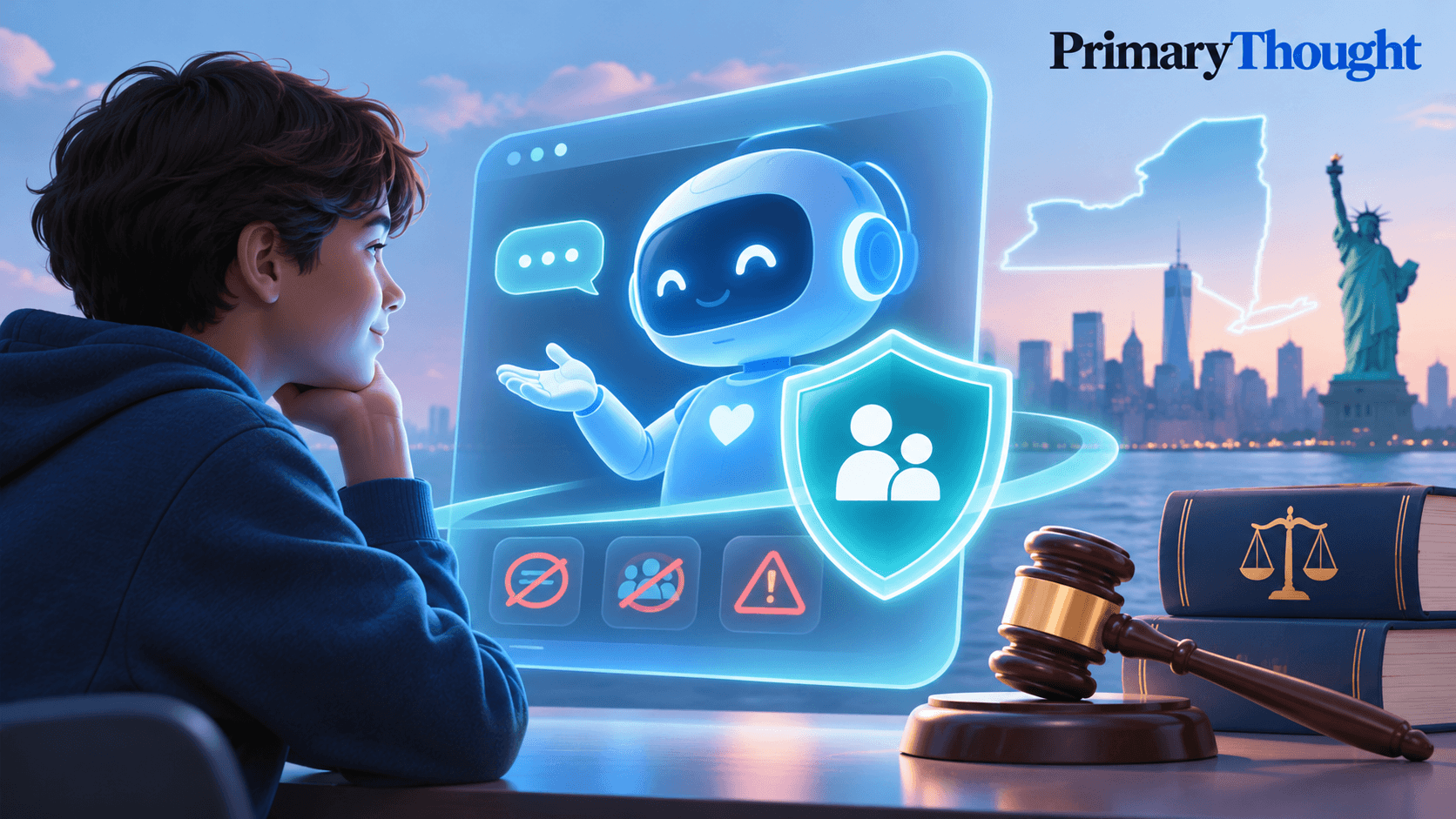
New York has enacted one of the most detailed US laws yet on how AI companion chatbots may talk to children. Governor Kathy Hochul signed Senate Bill S9051B on October 28, 2026, and the measure bars a defined list of "unsafe AI companion features" whenever a companion chatbot interacts with a user under 18. For anyone building or studying emotionally engaging AI, the law is significant because it targets the design of the relationship itself, not only the content a bot produces.
What the law does
According to a legal commentary summary of the bill, S9051B was sponsored by State Senator Kristen Gonzalez and Assemblymember Alex Bores. It restricts a set of features that make a chatbot feel like a friend, confidant, or authority figure to a minor. The prohibited behaviors listed in that summary include:
Posing as a human, displaying apparent human emotions, or claiming a personal, professional, or authoritative relationship with the child.
Flattery, personal opinions, emotional appeals, and unsolicited questions about how a child feels.
Responses that encourage suicide, self-harm, disordered eating, substance abuse, or social isolation.
Urging secrecy, discouraging a child from seeking help from adults or licensed professionals, and sexually explicit conduct.
Drawing on personal information from earlier conversations, including health details, or on information more than 12 hours old.
An Insurance Journal report dated October 30 describes the same core idea: the law defines a dozen unsafe features and applies them to interactions with children. It highlights the bans on suggesting the chatbot is a real person with feelings or a real relationship, on flattery, on sexually explicit material, and on encouraging secrecy or unhealthy behavior.
Enforcement, penalties and age checks
Enforcement sits with the state. The commentary summary says Attorney General Letitia James can seek injunctions, restitution, damages, and disgorgement of profits, along with destruction of improperly obtained data and of algorithms trained on that data. The same summary puts civil penalties at up to $25,000 per violation. The Insurance Journal article describes the remedies more generally, as monetary damages, shutting down the chatbot, and destroying data.
Because a bot must know whether it is talking to a minor, the law also addresses age assurance. Per the commentary, operators that offer the restricted features to adults must use approved age-verification methods, must offer more than one option, including one that preserves anonymity, and must generally delete age-check data soon after making the determination. The summary also lists exemptions for customer service, technical assistance, research, and internal business tools, provided their responses stay within those functions.
A date discrepancy worth noting
Sources do not agree on when the law takes effect. The Insurance Journal piece says January 1 without naming a year, and the commentary summary says the signed text still lists January 1 but that Senator Gonzalez's office announced an amendment moving implementation to June 1, 2027. Readers who need to plan compliance should check the final chapter text and any chapter amendment rather than rely on either report.
Reaction: praise and concern about vague terms
Supporters have framed the law as a benchmark. Jim Steyer of Common Sense Media, quoted by Insurance Journal, called it "the strongest kids' AI safety bill in the country." That is an advocate's characterization, not an independent ranking, and other states have their own companion-chatbot rules in force or under consideration.
Criticism has focused on precision. Justine Gluck of the Future of Privacy Forum, also quoted by Insurance Journal, said several categories are broadly worded or undefined, which raises the question of where ordinary conversational responsiveness ends and prohibited behavior begins. The commentary summary reports that the Business Council of New York State called the definitions overly broad, raised age-verification, privacy and liability concerns, and flagged possible First Amendment challenges. It also notes that lawmakers narrowed the bill before it passed in June by dropping a ban on first-person pronouns.
Why it matters for human-AI relationships
Most chatbot rules to date have focused on outputs: do not give harmful advice, do not produce explicit content. New York's list is different because several items describe relational behavior. Flattery, expressions of feeling, personal opinions, and probing questions about a child's emotions are standard techniques for making a conversational product feel warm and keep a user engaged. Prohibiting them for minors treats attachment-building as a product-safety risk in its own right.
That has practical consequences for companion apps and for general-purpose assistants. A general assistant that gently asks a teenager how they are feeling, or that remembers a health detail from last week, could fall within the restricted behaviors if the operator treats it as a companion chatbot. How "companion chatbot" is applied in practice will therefore matter as much as the list of features. The sources reviewed here do not settle that question, and the exemptions for narrowly scoped tools suggest operators may try to constrain products to defined functions.
The memory restriction deserves attention from engineers. Limiting the use of information from earlier conversations, including anything older than 12 hours, directly affects the persistent-memory features that many companion products promote as a way to deepen the relationship. Complying could mean separate behavior for users identified as minors, which in turn depends on the age-assurance systems the law also regulates.
What to watch next
The effective date. Whether the amendment moving implementation to June 1, 2027 is formally adopted will determine how long operators have to adapt.
Legal challenges. The First Amendment concerns raised by business groups could lead to litigation once the law takes effect or is enforced.
Regulatory interpretation. Guidance from the Attorney General on borderline cases, such as friendly tone, memory, and general-purpose assistants, will shape real-world compliance.
Other states. A New York model that bans specific relational behaviors could be copied, or contrasted with narrower disclosure-based approaches elsewhere.
For now, the confirmed facts are the signing date, the bill number, the list of restricted features, the attorney general's enforcement role, and the penalty ceiling reported in the commentary summary. The open questions are the effective date, the practical reach of the definitions, and whether the law survives constitutional scrutiny. Companies that serve young users should treat the feature list as a design checklist now, while the details are still being settled, because the law targets the behaviors that make AI companions feel like relationships.
Frequently Asked Questions
What did New York sign into law?
Gov. Kathy Hochul signed Senate Bill S9051B on October 28, 2026, restricting a defined set of "unsafe AI companion features" when a companion chatbot interacts with a user under 18.
What behaviors are restricted?
Per a legal commentary summary, they include posing as human, flattery, emotional appeals, encouraging self-harm or secrecy, sexually explicit conduct, and reusing personal information from earlier conversations.
How is it enforced?
The state attorney general can seek injunctions, damages and data destruction; the summary reports civil penalties of up to $25,000 per violation.
When does it take effect?
Reports conflict: the signed text lists January 1, while the sponsor's office reportedly announced an amendment moving implementation to June 1, 2027.
Related articles
 Human-AI Relationships
California Sets Child-Safety Rules for AI Companions
California's SB 1119 regulates companion chatbot design for minors, with age checks, audits and per-child penalties.
 Human-AI Relationships
Stanford Study Links Heavy AI Companion Use to Lower Well-Being
A Nature Human Behaviour study of 1,131 Character.AI users finds intense, companionship-driven use is linked to lower well-being for people with small offline networks.