
Aleph Alpha Releases Kolibri, an Open German-English MoE
Aleph Alpha's Apache 2.0 Kolibri activates about 3B of 78B parameters per token and targets regulated users who self-host.
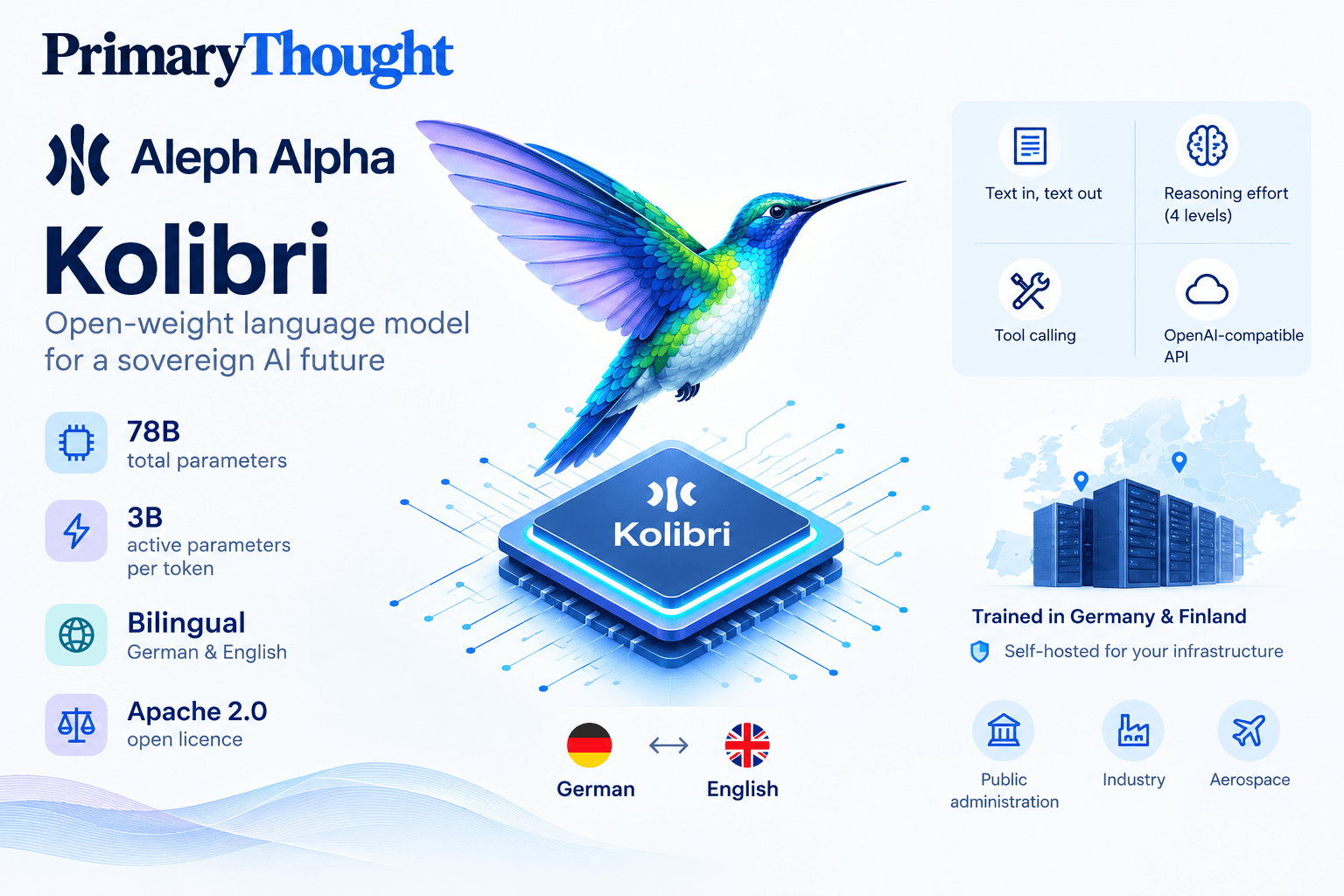
Aleph Alpha has released Kolibri, an open-weight German-English language model that uses a mixture-of-experts design to keep only about 3 billion of its roughly 78 billion parameters active for each token. Released in early October under the Apache 2.0 licence, it is aimed at public administration, industry and aerospace users who want to run a capable model on their own hardware. The release is a useful test of whether a bilingual, sovereignty-focused model can compete on cost and quality with larger general-purpose systems.
What Aleph Alpha released
According to a German-language report, Kolibri is a mixture-of-experts model with 78 billion total parameters, around 3 billion of them active per token, built bilingual in German and English from the start. A technical explainer from the model-routing company OrcaRouter gives the figures as about 78.1 billion total and 3.46 billion active, and dates the release to October 3, with weights on Hugging Face. The two sources date it a day apart, October 3 and October 4, so the exact day is best left open.
Both agree on the licence: the weights are Apache 2.0, and the explainer adds that there is no acceptable-use appendix or monthly-active-user threshold, terms that have complicated some other "open" releases. The model takes text in and gives text out, supports German and English only, and offers four reasoning-effort levels, tool calling and an OpenAI-compatible API.
Training and the German focus
The training numbers are the company's own. Pre-training covered about 20 trillion tokens, and about 21.3% of them, roughly 4.3 trillion, were German. The German report says Aleph Alpha built a new German-English tokenizer intended to handle German compound words more efficiently, which matters because inefficient tokenization raises the cost of every request in a language with long compounds. Training ran on infrastructure in Germany and Finland on 768 Nvidia B200 GPUs; the explainer puts the compute at around 392,000 GPU-hours and the energy use at about 950 MWh, excluding fine-tuning and reinforcement learning.
The German report also describes a predecessor, Kolibri Origin, with 30.6 billion parameters and a 65,536-token context, whose pre-training finished in June 2026. The explainer notes that this earlier model was never publicly released.
Context length: a point of disagreement
The sources describe the context window differently. The German report's introduction cites up to one million tokens, but its training section gives a maximum trained context of 262,144 tokens. The explainer says the native context is 262,144 tokens, that quality was validated up to about one million, and that the model card recommends staying at or below 262,144 for latency-sensitive and complex tasks. Readers planning long-document work should treat 262,144 as the safe working figure and check the model card for the extra configuration needed above it.
Grounding and regulated use
The distinguishing feature Aleph Alpha emphasises is grounding. According to the German report, the model is trained to decline to answer when the supplied documents do not adequately support an answer, using the company's own "Merlin-Arthur" method with synthetic positive and negative examples. In company tests, Kolibri gave unsupported answers less often than Kolibri Origin. That is a comparison with the company's own earlier model, not with competitors, and no independent measurement was found.
For regulated users, the pitch is practical rather than abstract. The model can be run on a customer's own infrastructure without sending internal data to an outside inference service, and Aleph Alpha has built its own evaluations for public administration, semiconductors, automotive, drive technology and aerospace. Those internal evaluations are exactly the kind of test that outsiders cannot reproduce from the announcement.
How it measures up
The most useful detail is a candid one. The explainer reports that on Aleph Alpha's own comparison, Kolibri at high reasoning effort averages 75.5 on English tasks and 70.8 on German, and that Qwen3.8 27B scores higher on most rows, while Nemotron 3 Super leads on AIME 2025. The vendor's claim, as the explainer puts it, is a strong trade-off between quality and serving cost, not that Kolibri is the most capable model. The German report is more general, saying the company calls the model competitive in math, coding, long-context work and agentic tasks.
The explainer also says no independent evaluation has been published and that there is no Artificial Analysis listing. Until third-party results appear, the benchmark picture rests on a vendor-run comparison that already concedes ground to a dense model of a third the size in total parameters.
Running it
The mixture-of-experts design lowers compute per token but not memory. The explainer says the FP8 weights need about 78 GB, so the minimum setup is two A100 80GB or two H100 GPUs, or a single H200, B200 or B300. Serving uses Aleph Alpha's inference package, a plugin for vLLM, or its container image. There is no vendor-hosted API, so using Kolibri means self-hosting, which fits the sovereign-deployment audience but limits casual experimentation.
What to watch next
Several things will decide how significant the release proves. Independent benchmarks, especially on German-language tasks, will show whether the tokenizer and data mix give a real edge. Evidence on the grounding behaviour from outside users would test the claim that the model declines unsupported answers. The German report also mentions that Aleph Alpha recently merged with Cohere, but gives no details on how that relates to Kolibri, so any clarification of the company's direction would be worth following. Finally, adoption by public bodies and industrial users, the stated target, will show whether an open, self-hosted German-English model meets a demand that larger multilingual systems have not.
Frequently Asked Questions
What is Kolibri?
An open-weight German-English mixture-of-experts language model from Aleph Alpha with about 78 billion total parameters and roughly 3 billion active per token.
What licence does it use?
Apache 2.0, according to both sources reviewed.
What context length does it support?
Sources agree on 262,144 tokens natively; one says quality was validated up to about one million tokens, and the model card advises staying at or below 262,144 for demanding tasks.
Can I use it through an API?
Not from the vendor. The explainer says there is no vendor-hosted API, so it must be self-hosted, needing about 78 GB of memory for FP8 weights.