
Hotel Guests Want AI Behind the Scenes, Surveys Suggest
A Mews survey finds 89% of guests want hybrid or background AI, while Zonal data shows 19% already use AI to choose venues.
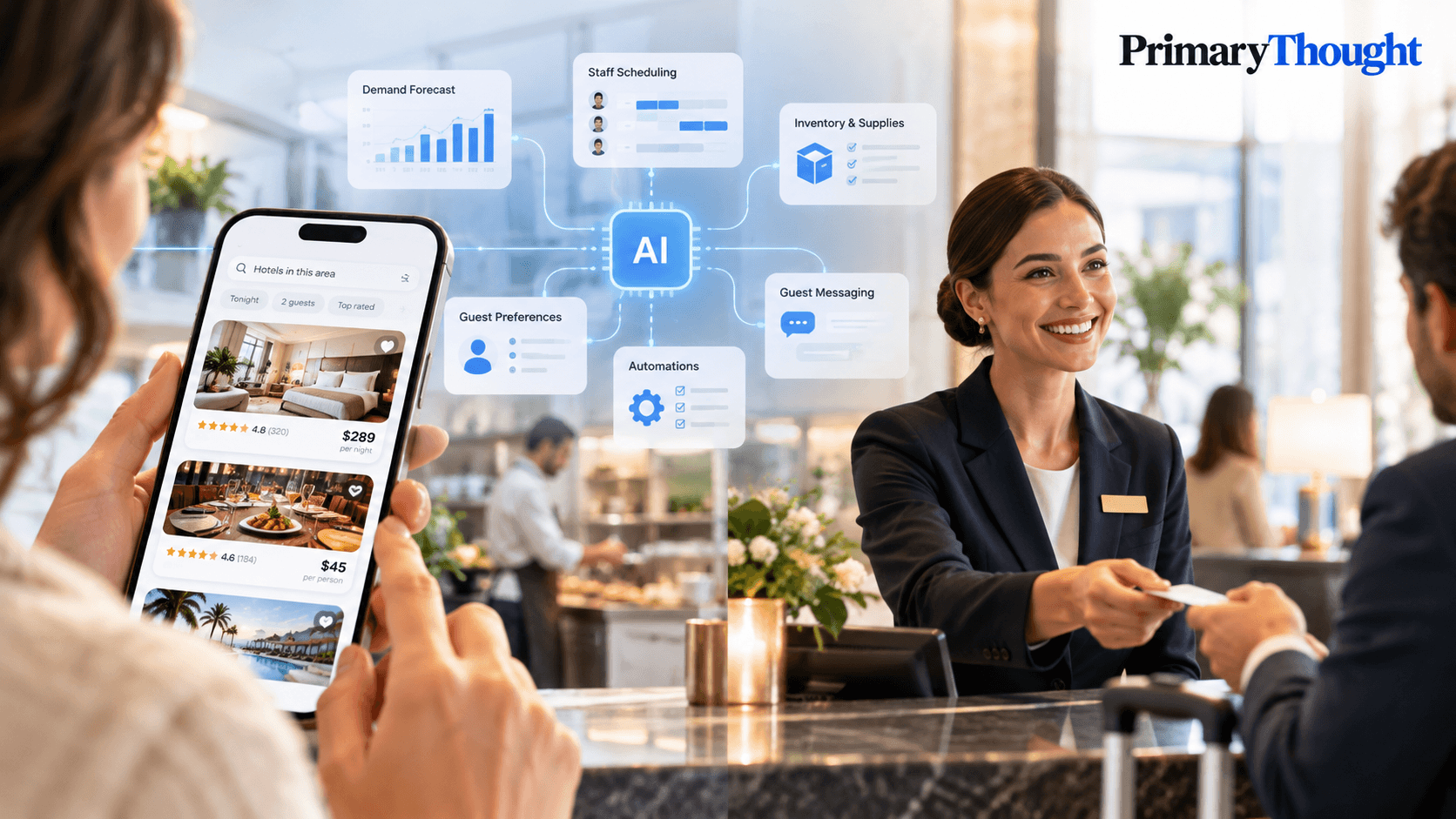
Two pieces of research published this week point to the same tension in hospitality: guests are open to AI that works out of sight, but they still want people at the moments that feel like service. A survey from hotel software company Mews, released on 7 October 2026, found that 89% of guests want either a hybrid stay or AI quietly handling repetitive tasks. A separate report from Zonal, covered on 8 October, shows consumers already using AI to decide where to eat and drink.
Both studies were commissioned or run by technology vendors with a commercial interest, so the findings are best read as industry signals and not neutral measurements. Taken together, they sketch where AI is likely to be welcomed in the service industry and where it may meet resistance.
What the Mews survey found
According to the Mews press release, the company surveyed 3,250 travellers across France, Germany, Italy, the Netherlands, Spain, Sweden, the UK and the US, with fieldwork in July 2026. The headline result is that 89% want either a hybrid stay that blends AI and human service, or AI working in the background on repetitive tasks. Very few want an AI-led stay.
The results by touchpoint show where the tension lies. Mews says guests preferred humans over AI across all nine touchpoints tested, although the release provides figures for only five. For bar and restaurant service, 72% preferred human staff, followed by 66% for the front-desk welcome and 58% for check-in and room key collection. For room service orders, 50% preferred a human, compared with 23% who preferred AI. Even for arranging taxis, which Mews describes as the most suitable task for automation, 44% preferred a human, compared with 28% who preferred AI.
Other findings concern attitudes. Mews reports that 75% say good hospitality depends on human staff regardless of the technology behind it, and 59% believe AI should take on repetitive tasks so employees can focus on rapport and trust. On jobs, 67% would worry about staff losing work to AI, and 51% disagree that they would not care if a hotel cut staff to adopt AI.
Mews founder Richard Valtr is quoted as saying that guests are telling the industry exactly where they want AI and where they do not, and that the hotels that win the next decade will not be the ones that automate the most. The company recommends automating routine tasks such as check-in and check-out, upselling, translation and guest messaging, as well as back-office work such as pricing, housekeeping coordination and reporting.
How much weight the survey can bear
Mews sells property management and point-of-sale systems, and the findings arrive in its own release. The release does not describe how respondents were recruited, how the questions were worded, or the margin of error, and it does not say how the nine touchpoints were chosen. The "89%" figure also combines two different preferences, hybrid service and background-only AI, so it should not be read as 89% opposing front-of-house automation. Those caveats do not make the result meaningless, but they limit how far it can be generalised.
There is also a gap between stated preference and behaviour. Surveys that ask guests whether they prefer humans tend to capture an ideal, whereas actual choices are shaped by price, convenience and speed. A guest who says they prefer a person at check-in may still use a kiosk or app if the queue is long.
Guests are already using AI to choose where to go
The second data point comes from Restaurant Online, reporting on Zonal's latest GO Technology report, produced with NIQ and based on more than 5,000 British consumers. It found that 19% already use AI tools to plan visits to pubs, bars and restaurants, with a further 50% considering it. The report identifies ChatGPT and AI-generated search summaries as tools consumers use to plan their visits.
Those who do use AI look for reviews and ratings (45%), average food and drink prices (43%), menus (38%), opening times (35%) and deals (28%). Use is higher among frequent diners and bigger spenders: 42% of people eating out more than three times a week use AI, and 23% of those spending over £60 per head do, against 14% of those spending under £5. Gen Z is at 34%, and London consumers at 39% compared with 16% elsewhere in the UK.
Trust appears high: 76% entirely or mostly trust AI engines to find a venue, and 72% say the same of AI-generated search summaries. Traditional channels still lead, though, with friends and family recommendations at 47%, online reviews at 32% and venue websites at 25%.
Tim Chapman, Zonal's chief commercial officer, described AI as rapidly becoming part of the customer journey and an opportunity for operators to improve their visibility. Karl Chessell of NIQ said AI can help discovery but raises challenges around accuracy, prioritisation and brand reputation, calling it a critical battleground for hospitality.
What this means for operators
Read side by side, the two reports describe AI sitting at opposite ends of the guest journey. Before arrival, AI is becoming a discovery layer that decides which venues a customer even considers. During the visit, guests say they want people. That suggests operators have a different job at each end: earn visibility in AI-generated answers, and protect the human contact that guests say defines good service.
The discovery side is more urgent and less within an operator's control. If AI tools summarise reviews, prices and menus, then accurate, current listings matter more, and errors in those sources could cost bookings. Chessell's warning about accuracy and brand reputation points at exactly this risk, though the report coverage does not quantify how often AI answers about venues are wrong.
The in-venue side is about staffing. The Mews data suggest guests tolerate automation of routine, repetitive work and worry about job losses. That implies a communication challenge for hotels and restaurants as much as a technical one: how they explain AI use to guests who are already uneasy about its effect on staff.
What to watch next
The useful follow-up evidence would be behavioural, not attitudinal: booking data showing how AI-referred diners convert, and operator results showing whether back-office automation frees time that staff actually redirect to guests. Until then, the two industry-funded surveys point to the same trend: AI working behind the scenes while human staff handle guest interactions. However, neither study has shown whether guests' actual behaviour matches their stated preferences.
Frequently Asked Questions
What did the Mews survey find?
Of 3,250 travellers, 89% want a hybrid stay or AI working quietly in the background, and humans were preferred at all nine touchpoints tested, per Mews.
How many consumers use AI to choose venues?
Zonal's report, produced with NIQ, found 19% of more than 5,000 British consumers use AI to plan pub, bar and restaurant visits.
Are the surveys independent?
No. Mews and Zonal are hospitality technology vendors, and the Mews release gives no sampling method or margin of error.
Related articles
 Service Industry AI
Bojangles Expands Hi Auto Drive-Thru AI to 100 More Restaurants
Bojangles extends its partnership with Hi Auto, expanding Bo-Linda voice AI to nearly 600 restaurants by mid-2027, with smarter upselling and vehicle-based order matching.