
Kronecker Product Attention Claims 10x KV Cache Savings
A new arXiv preprint factorises the KV cache with Kronecker products, claiming up to 10x compression on small models. The evidence is early.

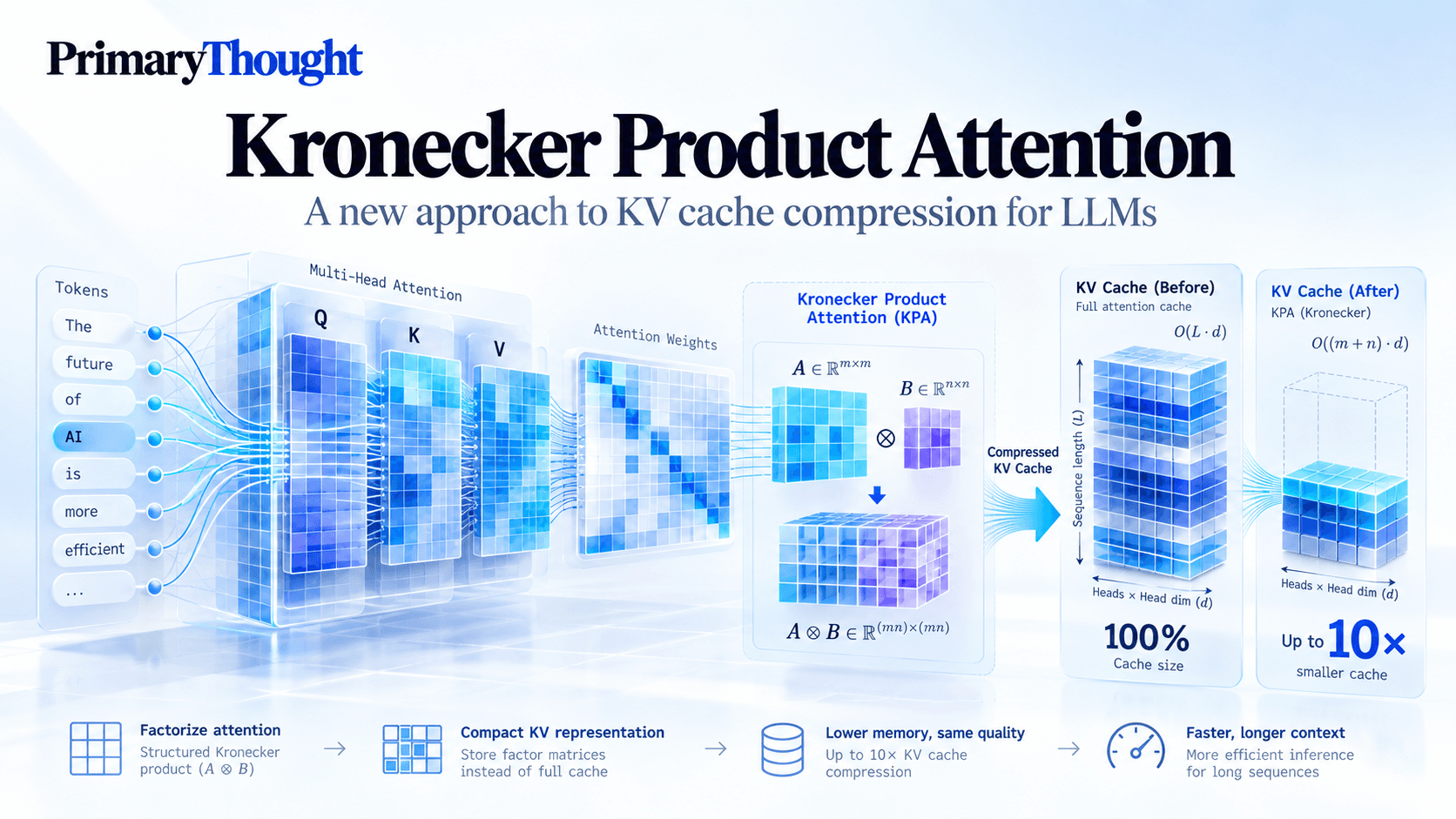
A preprint posted to arXiv on 8 October 2026 proposes a new way to shrink the key-value (KV) cache that large language models keep in memory while generating text. The method, called Kronecker Product Attention (KPA), claims up to 10x KV cache compression while matching or beating several established attention designs on small-scale benchmarks. It is an early, unreviewed result from small models, but it is a useful window into one of the most active problems in applied machine learning: how to make long, fast text generation cheaper in memory.
The problem: a cache that grows with every token
When a transformer generates text, it stores the key and value vectors of every earlier token so it does not have to recompute them. According to the KPA abstract, that cache grows with sequence length, batch size and model depth, and it constrains autoregressive generation. The standard attention design, multi-head attention (MHA), stores full keys and values for every head. Over the past few years researchers have proposed several ways to cut that cost: multi-query attention (MQA), grouped-query attention (GQA), multi-head latent attention (MLA) and tensor product attention (TPA).
The KPA authors argue each of these trades something away. In their framing, existing methods sacrifice expressivity, add complexity around positional encoding, or impose restrictive low-rank structure.
The scale of the possible savings is visible in earlier work. The DeepSeek-V2 paper, which introduced MLA, reported a 93.3% KV cache reduction compared with the company's earlier DeepSeek 67B model, alongside lower training cost and higher generation throughput. TPA, described in a paper by Yifan Zhang and colleagues, uses tensor decompositions to represent queries, keys and values compactly; its abstract describes the cache savings only qualitatively.
What KPA does
Based on the paper's full text, KPA splits the number of heads and the head dimension into two factors each. For every token, the key and value slices are written as a sum of Kronecker products of two small, input-dependent matrices. Only those compact factors are cached, not the full key and value tensors. Queries are never cached, so the number of query terms can be raised without adding memory. The paper uses two terms for keys and values and six for queries.
The authors say KPA strictly generalises TPA: with a particular choice of split, each Kronecker term collapses to the rank-one outer product that TPA uses. Attention scores can be computed directly from the compact factors, using an identity that turns the score into a head-level inner product times a feature-level inner product, so full key tensors are never rebuilt.
The head split is a tunable setting. The paper reports that symmetric splits give more compression, while asymmetric splits with a larger first factor gave the best accuracy in its ablations. The authors offer an explanation, that the first factor encodes joint interactions across heads, but present it as an interpretation rather than a proven result.
Positional encoding without a separate branch
Rotary position embeddings (RoPE) encode token position by rotating vectors. The authors design a Kronecker-separable version that rotates only one of the two cached factors, and show that attention scores still depend only on the relative offset between tokens. They note that, unlike MLA, this avoids a separate decoupled RoPE branch. That is a practical point, since extra branches complicate implementation.
The evidence so far
The experiments are modest in size. According to the paper, the authors trained Llama-style models at 125 million, 353 million, 773 million and 1.5 billion parameters on about 50 billion tokens of FineWeb-Edu, and evaluated zero-shot on nine benchmarks including ARC, BoolQ, HellaSwag, PIQA, WinoGrande, MMLU and SciQ.
Average accuracy figures reported in the paper's tables, in percent:
- 353M parameters: MHA 50.11, MLA 50.13, TPA 51.41, and KPA between 52.18 and 52.90 depending on the head split.
- 773M parameters: MHA 52.52, MLA 53.32, TPA 53.14, and KPA between 53.80 and 55.12.
- 1.5B parameters: MHA 54.49, MLA 54.08, TPA 55.01, and KPA 56.56 for the single configuration tested. KPA falls below MHA only on MMLU.
On memory, the paper's formula gives about 6.4x compression for TPA at the sizes tested, versus 6.4x to 8x for KPA at 353 million parameters and 10x at 1.5 billion. The abstract's "up to 10x" figure therefore refers to the largest configuration, not a general guarantee.
Why caution is warranted
Several features of the work argue for restraint. The paper was submitted to a workshop, and a preprint is not peer reviewed. The models are small, the training budget is limited, and the evaluation is short-context only, whereas cache compression matters most for long contexts. Results appear to be single runs without reported variance, and several gaps between methods are under one percentage point, which could fall within noise on benchmarks of this kind.
The paper has no dedicated limitations section, but its conclusion lists an efficient factored decoding kernel as a next step. That matters for a practical reason: saving memory does not automatically save time. Without an optimised kernel, the paper does not demonstrate faster generation, only a smaller cache. Another caveat concerns baselines. The paper says all models were trained under identical conditions, yet the 125-million and 1.5-billion-parameter baselines are cited from earlier TPA work, according to the full text. Readers should treat the comparison at those scales with care.
Where it fits
KPA is incremental in one sense and notable in another. It adds a tunable middle ground between full per-head storage and the heavily compressed schemes, and it keeps rotary embeddings simple. Its central claim, that block-structured factors can capture patterns a rank-one decomposition cannot, is plausible and testable. The authors' tables are consistent with it at small scale, but no result here shows that the advantage persists at the billions of parameters where cache memory becomes the binding constraint.
The wider context is that inference cost is now a first-order concern for AI developers, and attention variants are one of several levers alongside quantisation, batching and hardware. Each lever has its own failure modes, which is why independent replication matters.
What to watch next
Three developments would change the picture. The first is a released implementation: the arXiv page lists no code link, so independent reproduction is not yet possible. The second is a fast decoding kernel and measurements of real throughput and latency. The third is evaluation on longer contexts and larger models, ideally with multiple seeds. Until those arrive, KPA is best read as a promising design idea with encouraging small-scale numbers rather than a proven replacement for the attention variants already in production.
Frequently Asked Questions
What is Kronecker Product Attention?
KPA is a method from an 8 October 2026 arXiv preprint that represents cached keys and values as sums of Kronecker products of small, token-dependent factors to shrink the KV cache.
How much compression does KPA claim?
The abstract claims up to 10x KV cache compression, which the paper's formula ties to its 1.5 billion parameter configuration.
How was KPA tested?
On models of 125M to 1.5B parameters trained on about 50B FineWeb-Edu tokens and evaluated zero-shot on nine benchmarks.
What are the main caveats?
It is an unreviewed workshop preprint with small models, short-context evaluation, no reported variance, no released code and no demonstrated decoding speedup.
Related articles
 Machine Learning
MLPerf Training Adds First LLM Post-Training Benchmark
MLPerf Training v6.1 will time how fast systems train Qwen 3.5 397B with reinforcement learning to fix real software bugs.
 Machine Learning
Ai2 Releases Olmo-core 3, an Open MoE Training Stack
Ai2's Olmo-core 3 is an open training stack for mixture-of-experts models, with self-reported 52,000 tokens/sec/GPU on a 47B MoE and candid failure notes.
 Machine Learning
DeepSeek Releases Six Open-Source Tools for Huawei Ascend
DeepSeek released six open-source components, including TileLang and DeepGEMM, to make Huawei Ascend chips easier to use for training and inference.