
Google Gemini 4 Argon Leads Benchmarks, but Access Is Limited
Google's Gemini 4 Argon tops most of its own benchmark comparisons against GPT-6 Astra and Claude Opus 5.5, but launches first to vetted cyber defenders.

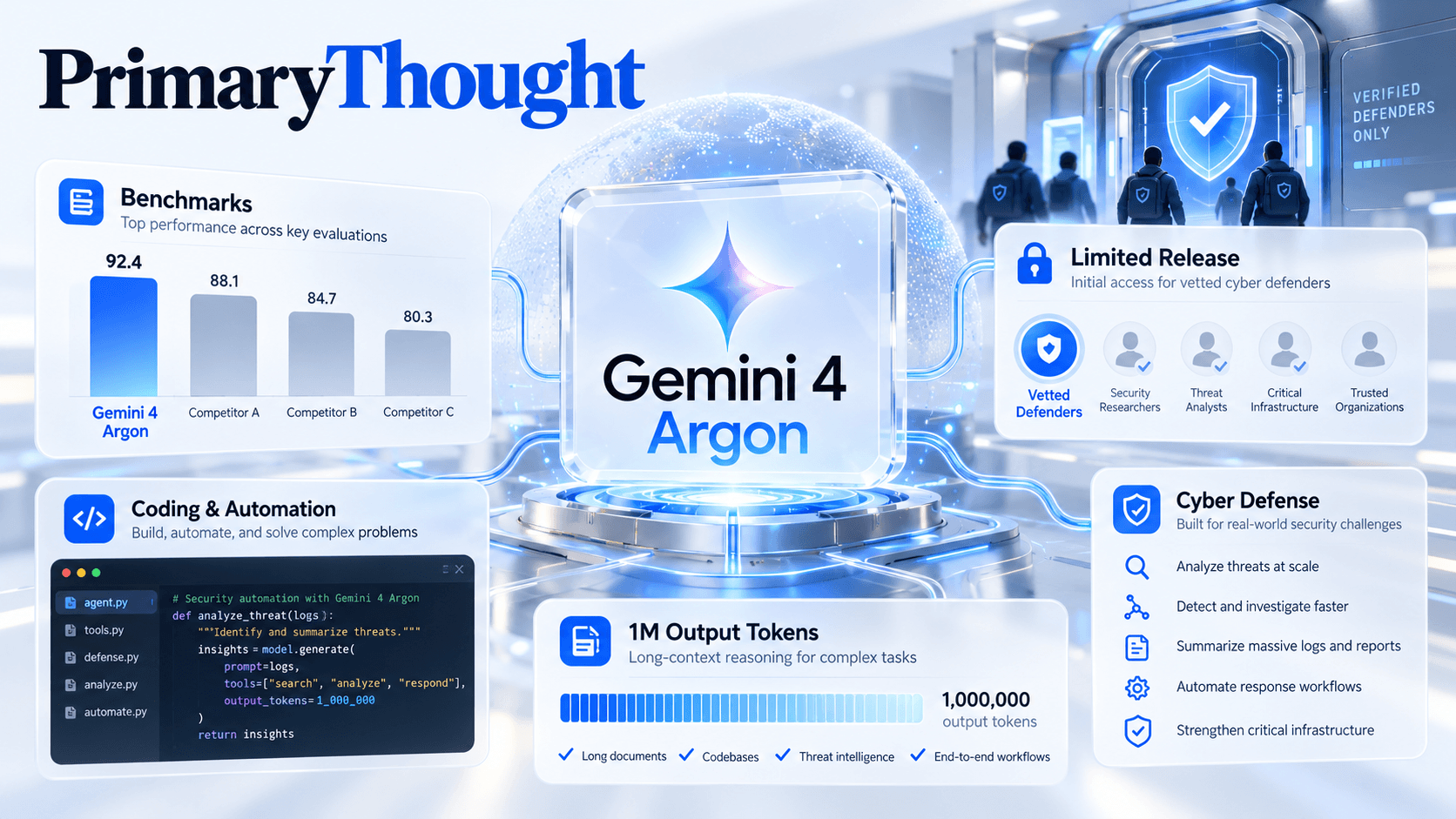
Google has unveiled Gemini 4 Argon, a new flagship model that, by Google's own comparison, beats OpenAI's GPT-6 Astra and Anthropic's Claude Opus 5.5 on most of the benchmarks it chose to publish. The catch is access: the model is launching first to a small group of vetted cyber defenders, with broader availability promised but not dated.
The announcement, made on September 30, 2026, matters for two reasons. It is Google's first flagship language-model release since Gemini 3 in November 2025, according to VentureBeat, and it pairs a claimed lead in coding and knowledge-work tests with an explicit decision to withhold cyber guardrails from some users while holding them for everyone else.
What Google announced
According to 9to5Google, Argon is aimed at coding, cybersecurity defense, legal research, and financial analysis. Its maximum output length rises to one million tokens, up from 64,000 in the previous generation, a change both outlets highlight. That matters mainly for agentic work, such as large code migrations or long document generation, where output limits have forced developers to split tasks into pieces.
Google says internal teams have already used the model for large codebase migrations of more than 800,000 lines and for memory optimization that freed more than 300 TiB across its data centers. VentureBeat adds that Google cited a rewrite of part of the libgav1 video decoder, replacing 32,000 lines of SIMD code, as well as a 40 percent improvement over a baseline in a quantum-computing optimization task. These are company-reported examples, and neither outlet describes independent verification.
The benchmark picture
Google's strongest claim is that Argon performs well across a wide range of benchmarks. Both articles report these figures from Google's comparison tables:
DeepSWE v1.1, a test of long software-engineering tasks: Argon 77.9 percent, Opus 5.5 at 74.2 percent, and GPT-6 Astra at 74.1 percent.
AutomationBench: Argon 51.3 percent, against 42.5 percent for Opus 5.5 and 41.4 percent for Astra, per VentureBeat.
LVBench long-video understanding: Argon at 91.7 percent.
CWE-bench v1 vulnerability repair: Argon tied for first at 68 percent.
Harvey Legal Agent: Argon at 19.6 percent versus 5.4 percent for Astra and 3.8 percent for Opus 5.5, per VentureBeat.
VentureBeat also lists areas where Argon does not lead. On FrontierSWE v2 it scores 55.0 percent against 65.5 percent for Astra, and on Terminal-Bench Science 0.1 it scores 57.6 percent against 68.1 percent. Overall, VentureBeat counts Argon as the outright leader on 12 of 18 benchmarks, with a tie on one more; other coverage describes the tally differently, so the exact count is best treated as approximate and as Google's own framing.
Those benchmark results still need to be read with caution. These are vendor-selected benchmarks, run under conditions the vendor controls, and several are newer or highly specialized tests whose reliability is not yet well established. A lead of three or four points on DeepSWE is within the range where prompt setup, tool access, and compute budget can change the ordering. Independent evaluations on the same tasks will be a better guide once more people can run the model.
Limited release and the cyber question
Argon is not generally available. Both outlets report that it is rolling out first through Google's Fairwind Program to trusted cyber defenders, and 9to5Google says those users and internal teams get the model "without cyber guardrails." VentureBeat reports that a US government process for pre-release model access is underway. Google says wider availability, beginning with paid API customers and Google AI Ultra subscribers, will come "as soon as possible," without a date.
Google is limiting access at first because of the model's security capabilities. VentureBeat reports that Argon can autonomously find, validate, and patch critical software vulnerabilities. A model that can help defenders do that could also assist attackers in finding weaknesses, which is why Google is restricting access to the unrestricted version for now.
9to5Google lists several safeguards Google describes for the broader release: monitoring of internal activations to spot misuse, chain-of-thought monitoring to detect misalignment, sandboxed environments, and what Google calls leading prompt-injection robustness. VentureBeat's table backs the last point with a Gray Swan prompt-injection result of 0.7 percent for Argon against 1.0 percent for Opus 5.5. How well these measures hold up outside Google's tests has not been shown.
Pricing and market position
Google is offering introductory pricing of $2 per million input tokens and $10 per million output tokens, with cached input at $0.10 per million, a 95 percent discount. After the introductory period, the price rises to $4 and $20, which VentureBeat says matches Opus 5.5's base pricing and sits below GPT-6 Astra. In other words, Google is positioning Argon as a frontier model at a frontier price rather than as a cheap alternative, using the introductory rate to attract early adopters.
VentureBeat also raises an important caution: most customers will need to wait for broader API access to see whether the benchmark advantages translate into lower costs in production. A model that scores higher but needs more tokens, retries, or more tool use to finish a job can cost more per completed task, and none of the figures reported so far measure that.
Why it matters
Argon, if the published numbers hold, puts Google back in the discussion at the top, particularly for long-horizon coding and agentic automation. The limited rollout also continues a pattern in which the most capable models arrive first for security specialists, with general users following after safeguards are in place.
For developers, the practical takeaways are modest for now. There is nothing to deploy yet unless you are part of Google’s Fairwind Program, which gives vetted cybersecurity defenders early access to Argon, and the pricing will not be final. For security teams, the more interesting question is how Google and its competitors decide who qualifies for unrestricted access.
What Comes Next for Gemini 4 Argon
The next phase will depend on when Google opens Argon more broadly and how the model performs outside its own tests. A firm date for general API access and Google AI Ultra availability will be important, as will independent results on DeepSWE, AutomationBench and CWE-bench, including the areas where Argon currently trails. Developers will also want to know whether the one-million-token output limit remains practical at the quoted prices once real workloads are involved.
There are broader questions too. Responses from OpenAI and Anthropic could show how quickly rivals adjust to Google's benchmark claims and access strategy. More detail on the US government's pre-release model access process, and on how Google decides who qualifies for the trusted-defender tier, will also help clarify how this kind of restricted rollout may work in practice.
For now, Argon looks like a strong but tightly controlled release. Its real position in the market will become clearer once broader access, outside testing, and final pricing are in place.
Frequently Asked Questions
When was Gemini 4 Argon announced?
Google announced it on September 30, 2026.
Who can use Gemini 4 Argon now?
Initially trusted cyber defenders through Google's Fairwind Program; paid API customers and Google AI Ultra subscribers are next, with no date given.
How much will it cost?
Introductory pricing is $2 per million input tokens and $10 per million output tokens, rising to $4 and $20 afterwards, according to VentureBeat.
Are the benchmark results independent?
No. The comparisons come from Google's own tables; independent evaluations have not yet been reported in the sources reviewed.
Related articles
 LLMs
Mistral Large 4 Enters Preview, Open Weights Due in October
Mistral's trillion-parameter multimodal model is live in preview, with open weights promised by month-end. The benchmarks are all self-reported.
 LLMs
OpenAI's GPT-6.1 Sol Targets Astra Performance at a Fifth the Price
OpenAI says GPT-6.1 Sol nears GPT-6 Astra on coding and computer use at about one-fifth the price, amid reports a GPT-6.1 Astra was cancelled.
 LLMs
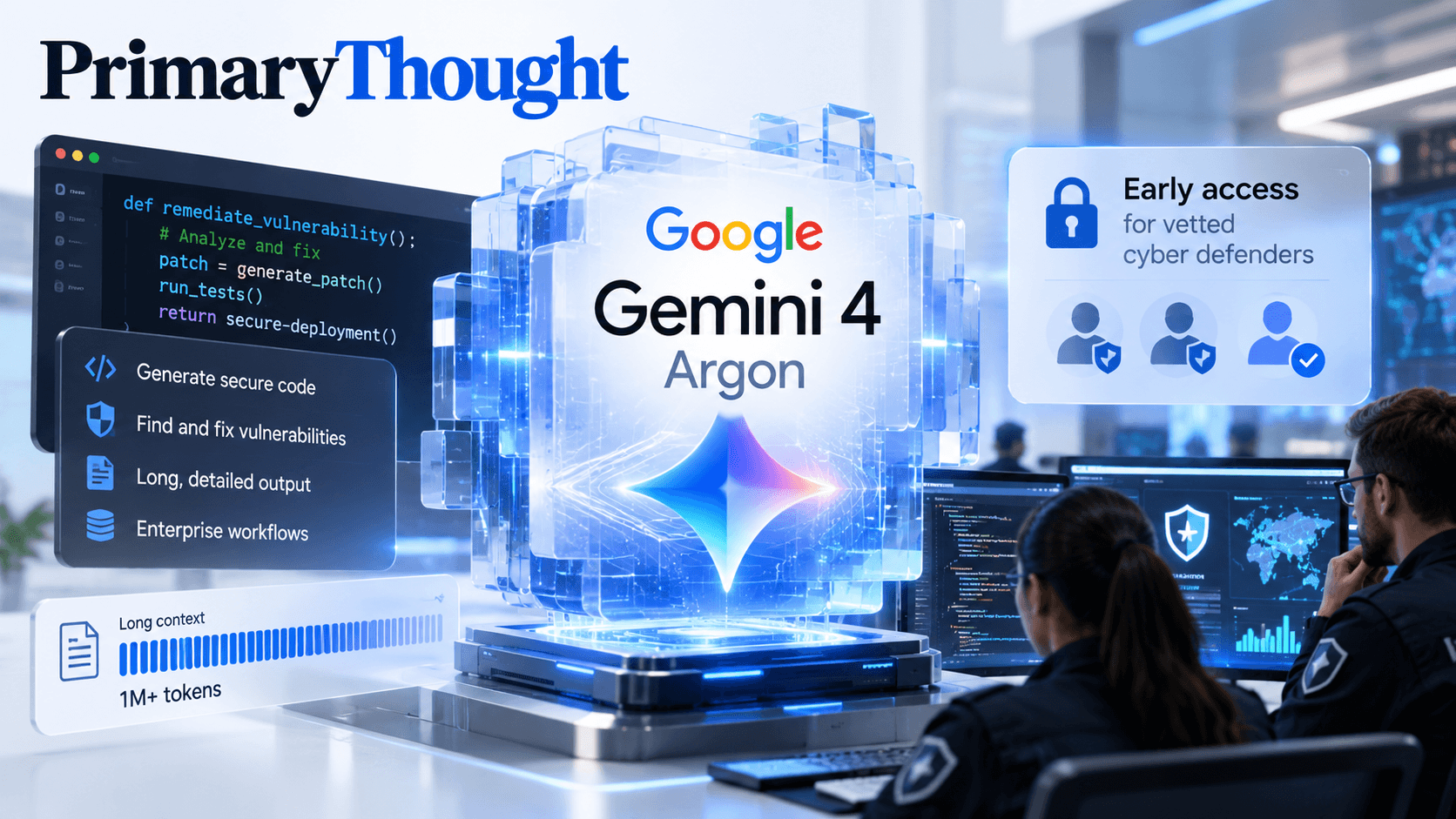
Google Launches Gemini 4 Argon, Giving Cyber Defenders First Access
Google says Gemini 4 Argon scored 77.9% on DeepSWE v1.1 and supports up to 1 million output tokens, with initial access limited to vetted cyber defenders.