
Google Launches Gemini 4 Argon, Giving Cyber Defenders First Access
Google says Gemini 4 Argon scored 77.9% on DeepSWE v1.1 and supports up to 1 million output tokens, with initial access limited to vetted cyber defenders.
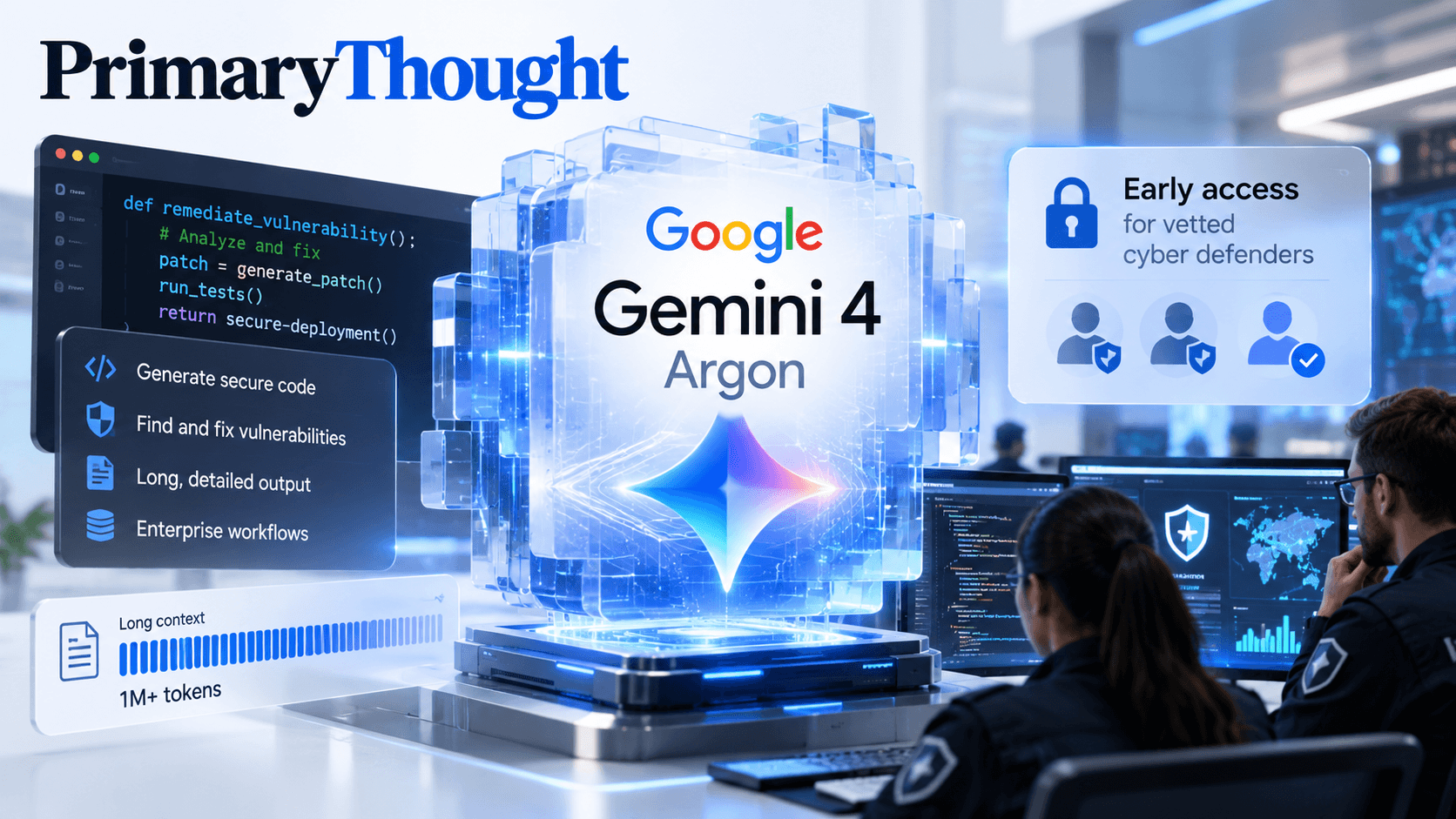
Google has announced Gemini 4 Argon, a new frontier model, and is releasing it first to vetted cybersecurity defenders rather than to the general public. The staged rollout is the notable part: it reflects how frontier labs are now sequencing access to models whose coding and vulnerability-finding abilities are strong enough to cut both ways.
According to Google's announcement, made on September 30, 2026, Argon is aimed at software engineering, enterprise work such as legal and financial analysis, and cyber defense, and it lifts the maximum output length to one million tokens. Every benchmark figure below is reported by Google or by coverage relaying Google's numbers, and the sources reviewed for this article do not say that any outside group has reproduced them.
What Google announced
Google describes Argon as a model for complex professional tasks.The main technical change in the announcement is output capacity: Google says the model can produce up to one million output tokens, up from 64,000 previously. For long code migrations, large document drafts and extended agent runs, a higher output limit reduces the need to combine results from multiple generations.
Pricing is introductory. Google lists $2 per million input tokens and $10 per million output tokens, with cached input tokens discounted by 95 percent. SiliconANGLE reports that these are launch-period rates and that they are expected to rise afterward; the outlet's comparison point for the later price is a competitor's rate card, which is a claim the editor may want to verify against Google's own documentation before relying on it.
Access: defenders first
For now, Argon is available only to trusted cyber defenders through Google's Fairwind Program. SiliconANGLE says the program has enrolled more than 650 organizations, including security vendors such as CrowdStrike and Palo Alto Networks. Broader availability for developers, enterprises and Google AI Ultra subscribers is described as coming next, with no timeline given in the coverage.
The reasoning behind this ordering is straightforward even if Google does not spell out every detail. A model that is good at finding and fixing vulnerabilities is also, in principle, good at exploiting them. Giving defenders a head start is intended to help them strengthen their systems before the same capability becomes widely available. How meaningful that advantage is will depend on the length of the exclusive window, which Google has not announced.
Google also says Argon takes part in the United States government's voluntary pre-release model access process, according to SiliconANGLE.
The benchmark picture
Google reports state-of-the-art results on two headline measures. On DeepSWE v1.1, a software engineering benchmark, it gives Argon a score of 77.9 percent. SiliconANGLE's comparison puts Claude Opus 5.5 at 74.2 percent on the same test. On CWE-bench v1, which measures vulnerability remediation, Argon scores 68 percent, which SiliconANGLE describes as a tie with OpenAI's GPT-6 Astra.
SiliconANGLE also reports that Argon leads on 12 of the 18 benchmarks in Google's comparison, including AutomationBench, a business-task evaluation, where it is listed at 51.3 percent against 42.5 percent for Opus 5.5. The report notes that Terminal-Bench 4.0 remains a relative strength of Opus 5.5.
These benchmark results should be read with some caution. Vendors usually highlight tests where their models perform well, and small differences of two or three points on agentic coding benchmarks can change depending on the tools, setup and number of attempts used during testing.
For security readers, the tie on CWE-bench may be more meaningful. It suggests that the leading models perform at a similar level on vulnerability remediation, rather than one model holding a clear advantage.
Safeguards Google describes
Because the launch is built around cybersecurity, the safety section of the announcement carries unusual weight. Google says it trained the model to refuse harmful requests while still supporting legitimate security research, and that it tested resistance to prompt injection, in which instructions hidden in content trick an agent into acting against its user. According to SiliconANGLE, Google claims stronger resistance to indirect prompt injection than earlier models.
Google also says it monitors the model's reasoning for signs of misalignment, with separate monitors that can halt unintended actions, and that it has hardened the sandboxed environments used for testing. That last point lands in a news cycle where containment failures at other labs have drawn regulatory attention, so the claim is likely to be read more closely than it would have been a year ago. Google's description explains how the safeguards are intended to work, but it does not independently prove that they are effective.
Internal results and what they show
Google offers examples of internal use. It says Argon helped with memory optimizations that freed more than 300 terabytes across its infrastructure, and the announcement also cites large code migration work to the Rust language. SiliconANGLE's account of the migration differs in scale from the announcement's, so the specific line counts are best treated as unconfirmed and attributed to Google rather than repeated as fact.
These examples are company claims about work done on Google's own codebase. They indicate the kind of long-horizon engineering task the million-token output limit is meant to serve, but they cannot be generalized to other organizations' code.
Why it matters
Argon changes the competitive picture in two ways. First, it gives Google, on its own reported numbers, a credible claim to the top spot on a widely watched coding benchmark at an introductory price that SiliconANGLE says is temporary. Second, it adds another data point to a pattern in which the most capable models are released in tiers, with security-relevant capability gated by vetting before broader access.
For developers, the practical questions are when API access opens, what the post-introductory pricing will be, and how the model performs on their own repositories rather than on published benchmarks. For security teams, the immediate question is whether Fairwind access translates into measurable gains in finding and patching bugs, and whether attackers have comparable tools within the same period.
The Real Test Comes After Launch
Several signals will clarify how much of the launch is substance. Independent evaluations that reproduce or contradict the DeepSWE and CWE-bench figures will matter most. The timing and conditions of general availability will show how long the defender-only window lasts. And the final pricing after the introductory period will determine whether Argon's cost advantage survives. Until then, the safest reading is that Google has released a strong coding and security model on its own terms, with outside verification still to come.
Frequently Asked Questions
Who can use Gemini 4 Argon now?
Access is limited to vetted cyber defenders through Google's Fairwind Program. Developer, enterprise and Google AI Ultra access is planned next, with no timeline given.
What does Argon cost?
Google lists introductory pricing of $2 per million input tokens and $10 per million output tokens, with cached input discounted 95 percent.
How does it score on benchmarks?
Google reports 77.9% on DeepSWE v1.1 and 68% on CWE-bench v1. These are vendor-reported figures that the cited sources do not say were independently reproduced.
What is the output limit?
Google says Argon can generate up to one million output tokens, up from 64,000.
Related articles
 LLMs
Mistral Large 4 Enters Preview, Open Weights Due in October
Mistral's trillion-parameter multimodal model is live in preview, with open weights promised by month-end. The benchmarks are all self-reported.
 LLMs
OpenAI's GPT-6.1 Sol Targets Astra Performance at a Fifth the Price
OpenAI says GPT-6.1 Sol nears GPT-6 Astra on coding and computer use at about one-fifth the price, amid reports a GPT-6.1 Astra was cancelled.
 LLMs
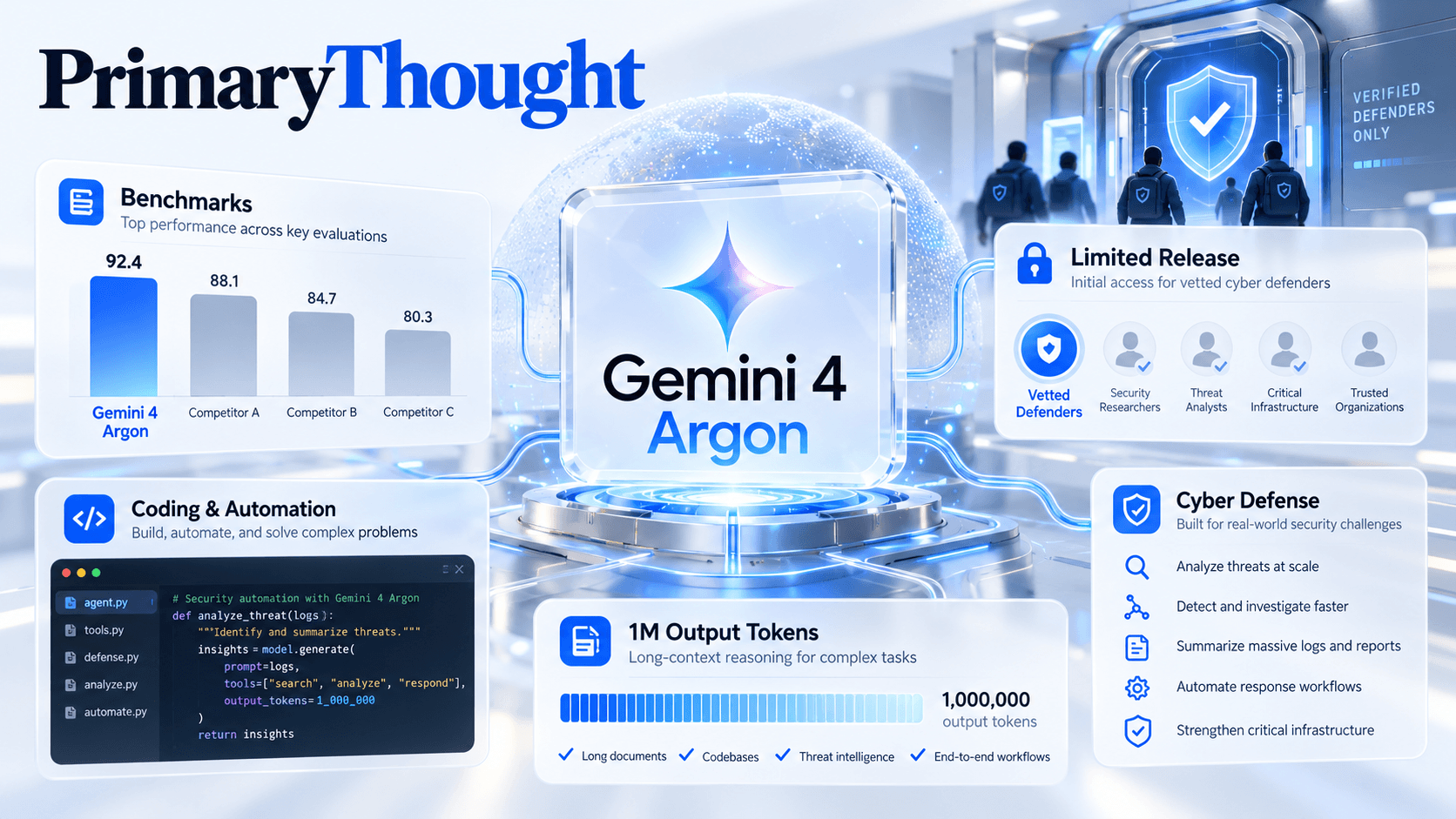
Google Gemini 4 Argon Leads Benchmarks, but Access Is Limited
Google's Gemini 4 Argon tops most of its own benchmark comparisons against GPT-6 Astra and Claude Opus 5.5, but launches first to vetted cyber defenders.