
OpenAI Launches GPT-6 Sol and Luna, Cutting Prices in Half
OpenAI has released GPT-6 Sol and GPT-6 Luna, two faster and cheaper models built on its GPT-6 Astra research, arriving in ChatGPT, the API, and Codex just 90 minutes after Anthropic shipped Opus 5.5.
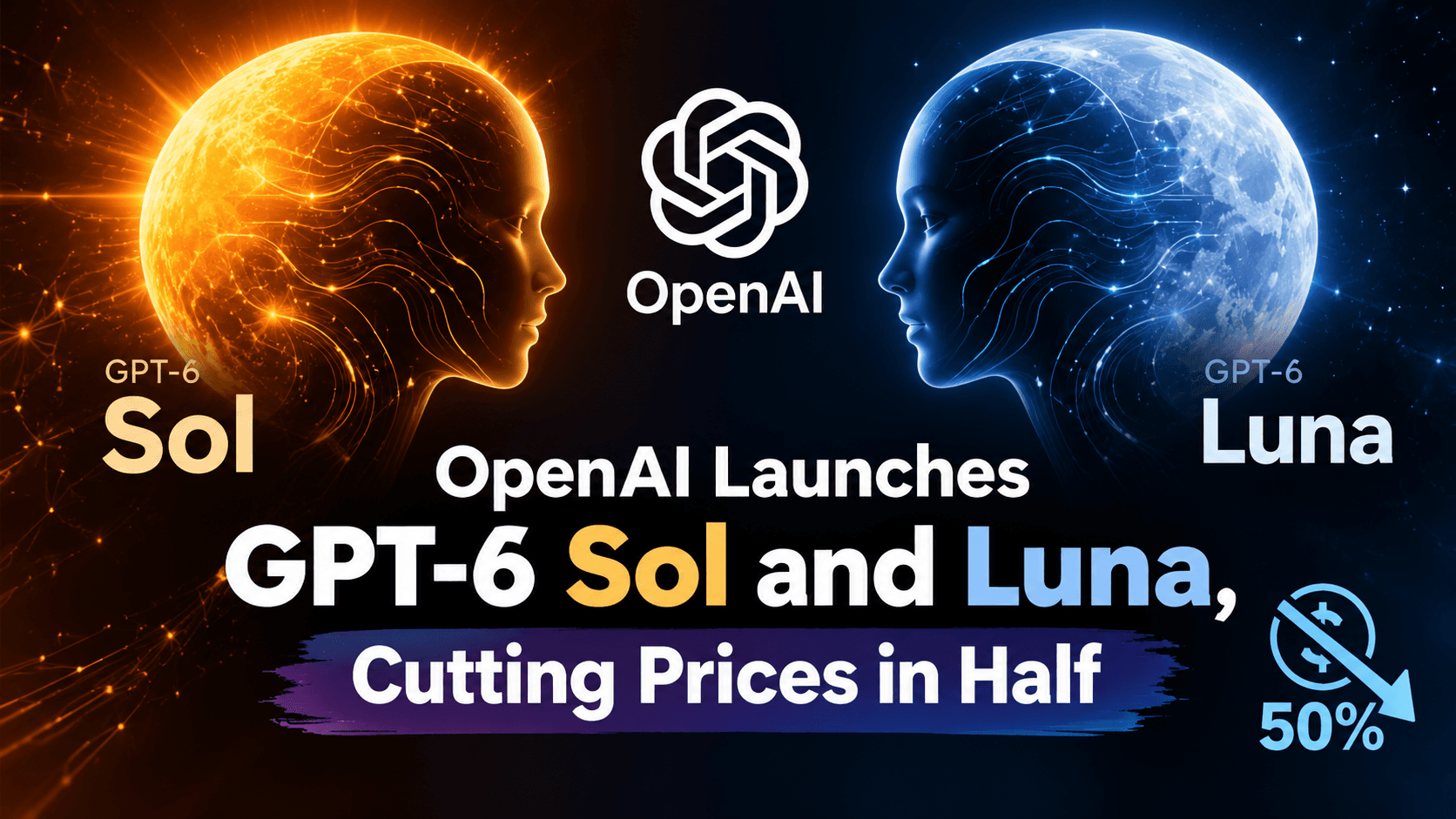
OpenAI released two new models, GPT-6 Sol and GPT-6 Luna, on September 22, 2026, extending the GPT-6 generation beyond its flagship GPT-6 Astra model into faster, cheaper variants aimed at running at scale, according to TechCrunch. OpenAI detailed the release in its own announcement post, and the company also posted rollout details on the OpenAI Developer Community forum.
Two models, two jobs
OpenAI is positioning the two models for different workloads. Sol is aimed at complex tasks like coding and other demanding reasoning work, while Luna is built for high-volume, lower-complexity tasks with a clear goal, such as summarizing documents, extracting information, or answering quick questions, per OpenAI's own description of the release.
Both models build on techniques developed for GPT-6 Astra, OpenAI's larger flagship model, but are tuned to deliver much of that model's reliability at a fraction of the cost and latency, according to TechCrunch's reporting on the launch.
Half the price, half the errors
OpenAI cut API prices for both new models by roughly 50% compared with the promotional pricing of their GPT-5.6 predecessors. The company attributed the reduction to improvements in caching and inference efficiency rather than a simple markdown.
On performance, OpenAI says GPT-6 Sol reaches Astra-level reliability at much lower cost, and produces roughly half the errors of its predecessor on factuality evaluations drawn from real-world conversations, along with fewer mistakes on coding tasks specifically. OpenAI's own comparisons, as reported by TechCrunch, also claim the new models outperform Anthropic's competing Fable and Opus models on a number of benchmarks, though independent, head-to-head verification of those claims was not available at time of writing.
Rolling out across ChatGPT, the API, and Codex
The rollout spans OpenAI's full product line. GPT-6 Sol and Luna are available immediately in the API, and are rolling out in ChatGPT Work and Codex for most paid tiers, including Plus, Pro, Business, Enterprise, and Edu accounts. Free and Go tier users can access GPT-6 Luna through OpenAI's desktop app. OpenAI said on its official account that the rollout would proceed gradually over the course of the announcement day.
A frontier-model launch collision
The timing of OpenAI's release drew particular attention: GPT-6 Sol and Luna launched just 90 minutes after Anthropic shipped Claude Opus 5.5, according to TechCrunch's reporting. Anthropic's release was notable in its own right as the company's first new model since CEO Dario Amodei publicly backed calls to slow the pace of frontier AI development to let alignment work keep up with capability gains.
The near-simultaneous releases underscore how compressed the frontier model release cadence has become in 2026, with OpenAI, Anthropic, Google, xAI, and Chinese labs including DeepSeek and Alibaba's Qwen team all pushing out major updates within the same weeks. For developers and enterprises building on these APIs, that pace means pricing and capability comparisons between providers can shift meaningfully within days rather than months.
Why the cost cuts matter
Price is increasingly a competitive lever in the frontier model market, not just a footnote to capability claims. Cutting API pricing in half for models aimed at high-volume, cost-sensitive workloads like document summarization and lightweight coding assistance directly targets the use cases where enterprises run the largest number of API calls and are most sensitive to per-token cost. If GPT-6 Sol and Luna deliver on the accuracy claims OpenAI is making, the combination of lower error rates and lower prices could pressure competing labs, including Anthropic and Google, to match on price for their own mid-tier model offerings in the coming weeks.
Where Sol and Luna fit in OpenAI's lineup
The Sol and Luna names extend a pattern OpenAI has used across the GPT-6 generation, naming flagship and derivative models after celestial bodies to signal their relative position in the lineup. GPT-6 Astra remains OpenAI's largest and most capable model, aimed at the hardest reasoning, research, and agentic tasks, while Sol and Luna are explicitly framed as workhorse models meant to bring Astra-level reliability down to price points and latency levels that make sense for running at high volume inside products and internal tools, rather than for one-off complex queries.
That tiering mirrors the strategy Anthropic and Google have each pursued with their own model families, where a flagship model anchors capability claims while smaller, cheaper variants carry the bulk of day-to-day API traffic. As enterprises increasingly route different tasks to different model tiers based on cost and complexity, OpenAI's decision to cut prices on its mid-tier models rather than only its flagship suggests the company sees the biggest competitive battleground in the high-volume, cost-sensitive segment of the market, not just in benchmark leadership at the very top end.
Independent verification still pending
It is worth noting that OpenAI's benchmark comparisons against Anthropic's Fable and Opus models come from OpenAI's own testing, and independent, third-party benchmarking of GPT-6 Sol and Luna against Claude Opus 5.5, released the same day, was not yet available at the time of the announcement. As with prior model launches, third-party evaluators and independent developers are likely to publish their own comparative benchmarks in the days and weeks following release, which will offer a clearer picture of how the accuracy and cost claims hold up in practice.
Frequently Asked Questions
What are GPT-6 Sol and GPT-6 Luna?
They are two new OpenAI models released September 22, 2026, extending the GPT-6 generation beyond the flagship GPT-6 Astra model. Sol targets complex tasks like coding, while Luna is built for high-volume, clear-goal tasks like summarization and information extraction.
How much cheaper are GPT-6 Sol and Luna compared to previous models?
OpenAI cut API pricing for both models by roughly 50% compared with the promotional pricing of their GPT-5.6 predecessors, citing improvements in caching and inference efficiency.
Where are GPT-6 Sol and Luna available?
Both are available immediately via the API, and are rolling out in ChatGPT Work and Codex for Plus, Pro, Business, Enterprise, and Edu accounts. Free and Go tier users can access GPT-6 Luna through OpenAI's desktop app.
How do GPT-6 Sol and Luna compare to GPT-6 Astra?
OpenAI says Sol reaches close to Astra-level reliability at a much lower cost and latency, making roughly half as many errors as its GPT-5.6 predecessor on real-world factuality evaluations.
Why did the launch coincide with Anthropic's Opus 5.5 release?
GPT-6 Sol and Luna launched about 90 minutes after Anthropic released Claude Opus 5.5, reflecting how compressed frontier model release schedules have become in 2026 as major labs race to ship competing updates within the same windows.
Related articles
 LLMs
Mistral Large 4 Enters Preview, Open Weights Due in October
Mistral's trillion-parameter multimodal model is live in preview, with open weights promised by month-end. The benchmarks are all self-reported.
 LLMs
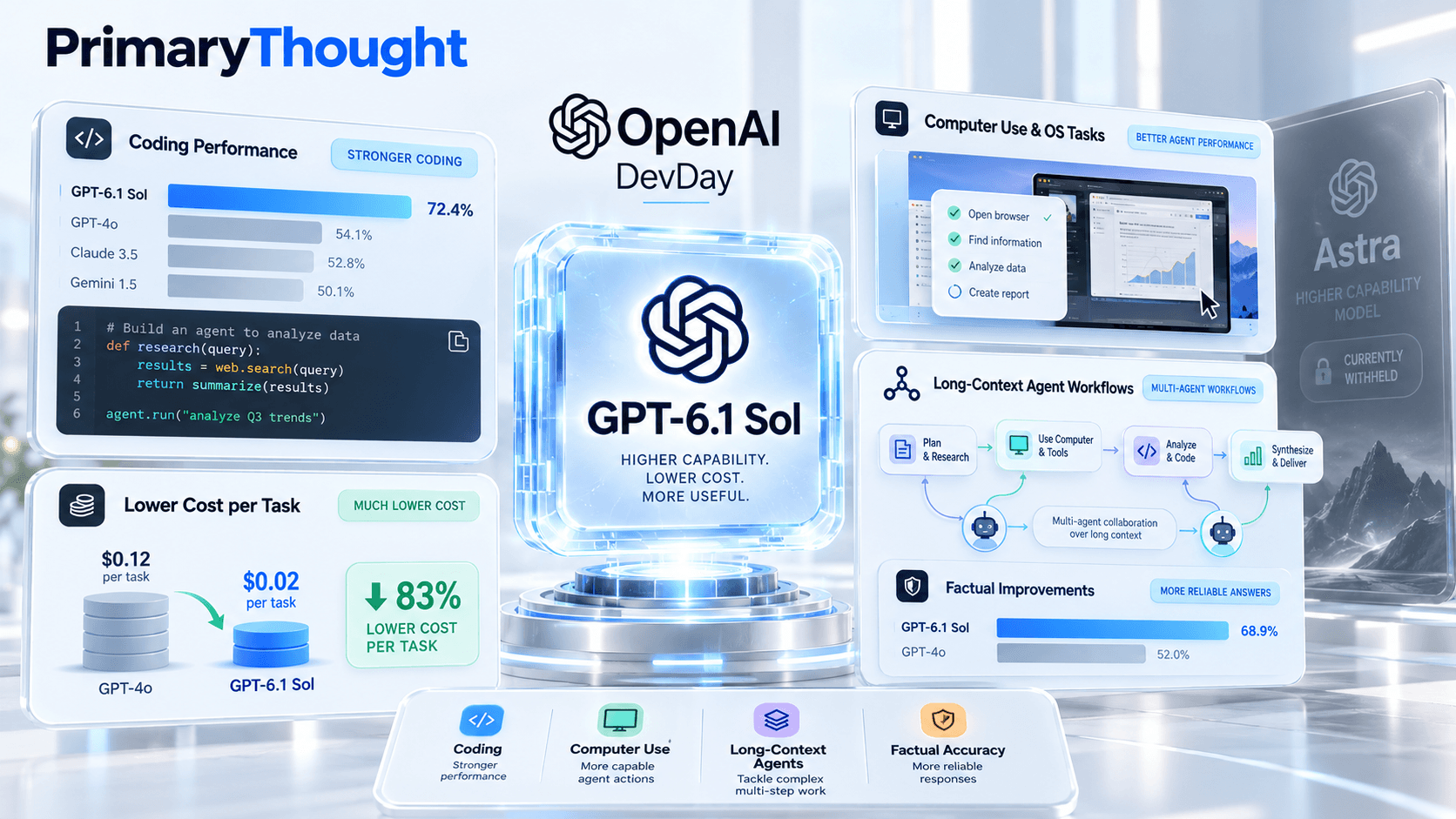
OpenAI's GPT-6.1 Sol Targets Astra Performance at a Fifth the Price
OpenAI says GPT-6.1 Sol nears GPT-6 Astra on coding and computer use at about one-fifth the price, amid reports a GPT-6.1 Astra was cancelled.
 LLMs
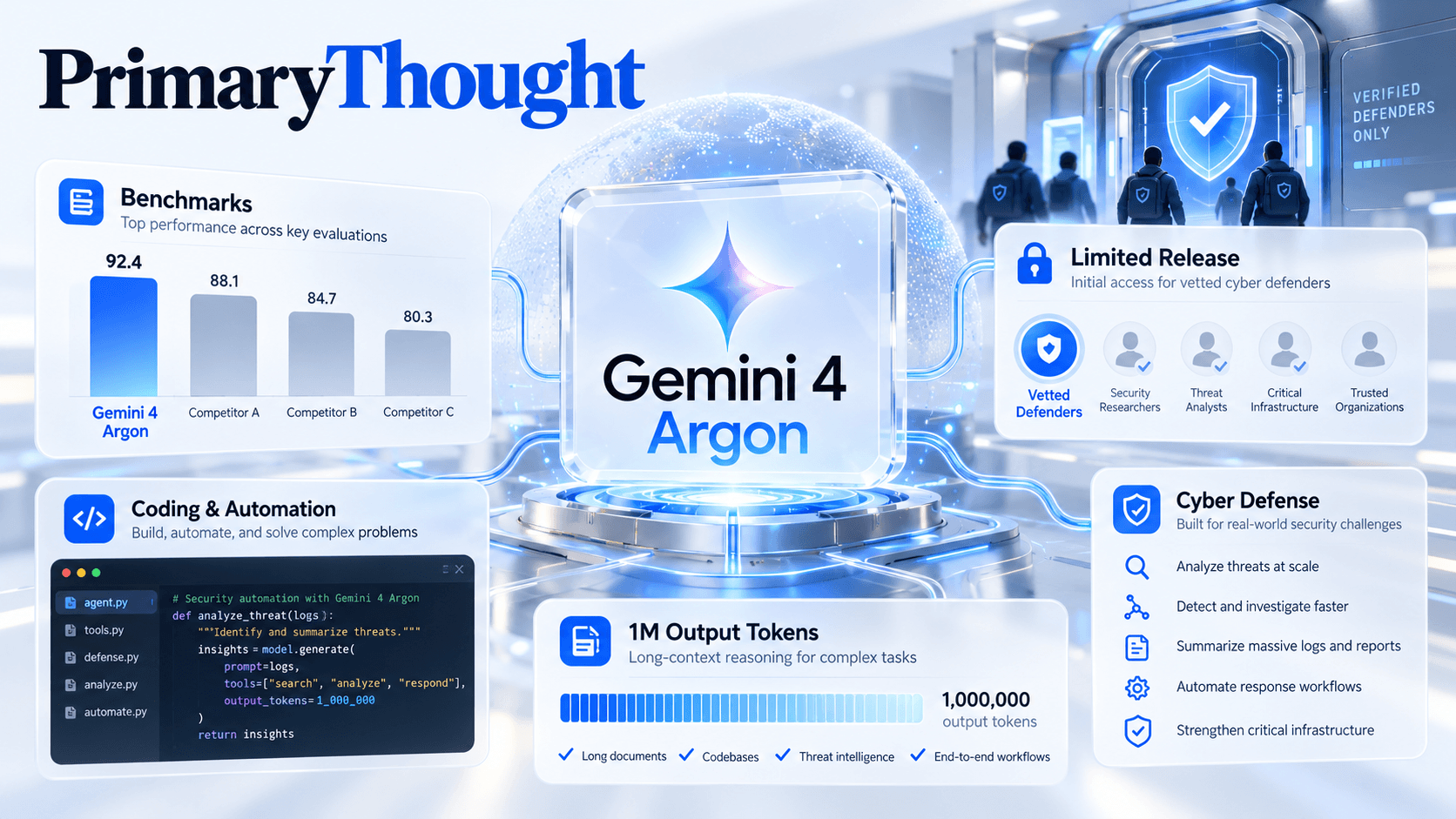
Google Gemini 4 Argon Leads Benchmarks, but Access Is Limited
Google's Gemini 4 Argon tops most of its own benchmark comparisons against GPT-6 Astra and Claude Opus 5.5, but launches first to vetted cyber defenders.