
Cloudflare Releases Open-Weight Clef Models for AI Agents
Cloudflare has released Clef and Clef-flash, open-weight AI decision models that return scored answers instead of generated text. Licensed under Apache 2.0, they enter a growing market alongside similar offerings from OpenAI and Amazon.
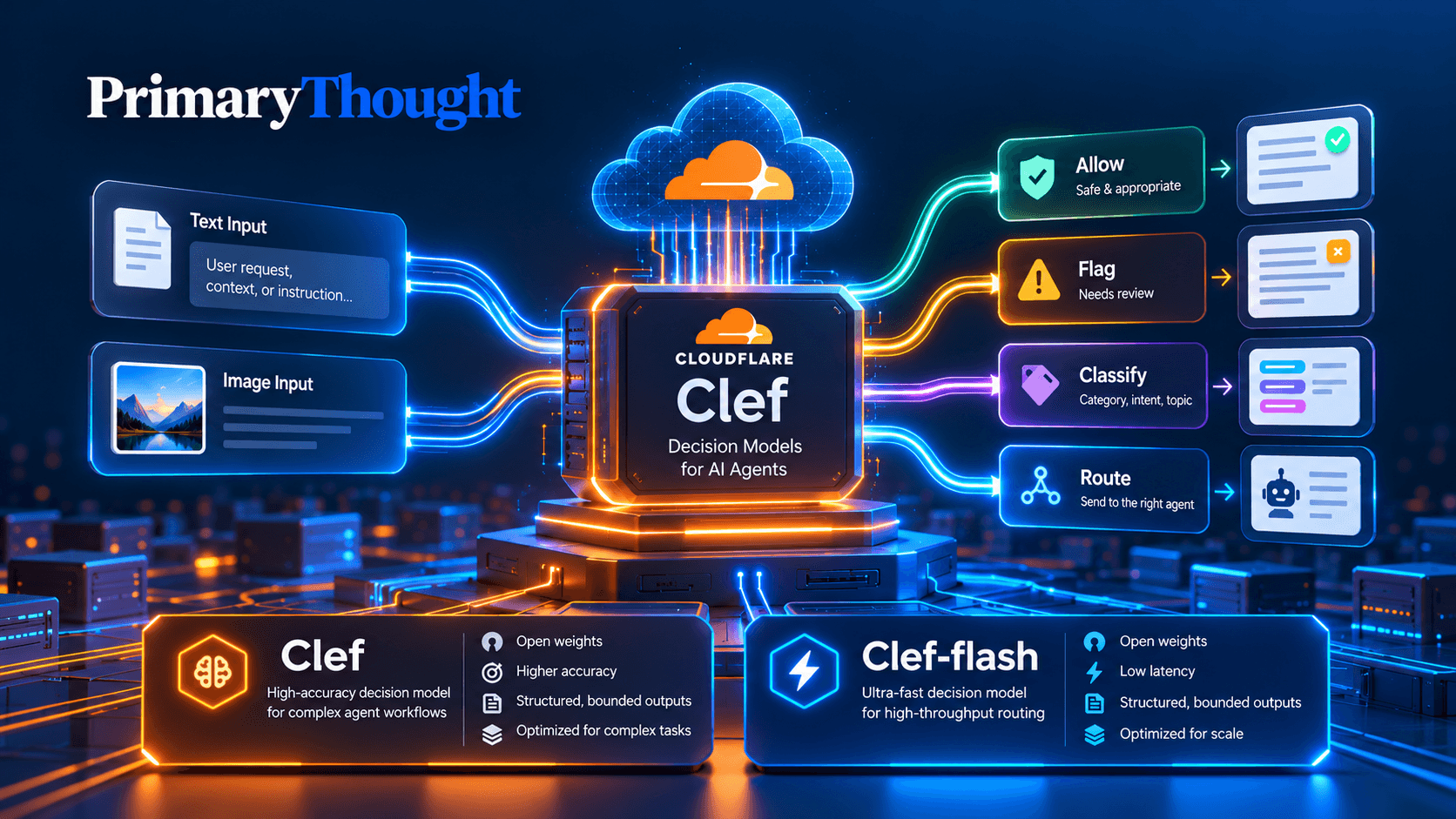
Cloudflare has released Clef and Clef-flash, a pair of open-weight models built to make the quick routing and classification calls that sit inside AI agent workflows, rather than to write text. The release, on October 1, arrives within days of a similar offering from OpenAI and one from Amazon, and it differs from both in one respect that developers will notice: according to coverage of the launch, Cloudflare is the only one of the three publishing full model weights. The move turns "decision models" into a small but contested category in the agent tooling stack.
What Cloudflare released
As described in Cloudflare's announcement, Clef is built on a 27-billion-parameter Qwen base and Clef-flash on a 9-billion-parameter one. Both are meant to produce what Cloudflare calls bounded, structured outputs cheaply, quickly, and consistently, which is the opposite of a general chatbot's open-ended prose. Instead of generating tokens one at a time, the models run a single prefill pass over the input and then score the valid answer choices in parallel. A developer supplies a question and a schema of allowed answers, and the model returns scores for them.
The weights are available on Hugging Face under the Apache 2.0 license, according to both the blog and a report from Startup Fortune. The models are also hosted on Cloudflare's Workers AI platform. Cloudflare says Clef supports a 64,000-token context window and accepts image inputs in addition to text. It also says the API is compatible with a specification called Jev, and that its models add vision support and a longer context than Jev, which it describes as text-only with a 32,000-token window.
The numbers Cloudflare reports
On latency, Cloudflare reports median figures of 209.3 milliseconds for Clef and 38.8 milliseconds for Clef-flash on Workers AI. In one internal example, its threat intelligence team uses Clef to label website domains with multi-label probabilities, such as a high likelihood of "fashion" and a near-zero likelihood of "phishing." Cloudflare says that workflow took 2.2 seconds, against 4.7 seconds for comparable LLM-based approaches.
On accuracy, the company says Clef leads the Jev Decision Index benchmark and cites sample results including 98.76% for Clef-flash on a function-calling exact-match measure (BFCL), 69.19% nDCG@10 for Clef on a tool-retrieval benchmark (ToolRet) and 94.20% macro-F1 for Clef on the BANKING77 intent-classification dataset. These are the vendor's own figures, and the sources we reviewed do not include an independent replication. Readers should also note that benchmark selection matters in a new category with no settled evaluation standard: a model can lead one index and trail on a different mix of tasks.
Cloudflare also describes the training approach. According to the blog, the models were trained with a label-smoothed cross-entropy objective combined with a Brier loss to improve probability calibration, plus a method it calls Reinforcement Learning for Calibrated Decisions. Calibration is the point of that effort. A routing model is only useful for gating if a reported 90% confidence behaves like 90%, because developers will set thresholds on those numbers to decide when to escalate to a larger model or a human.
The rivals: OpenAI and Amazon
OpenAI announced a Decisions API at its DevDay event. A summary from OpenTools dates the announcement to September 29, while the Startup Fortune report gives September 30, so the exact day is uncertain. Both agree on the substance. Developers define questions with a finite set of acceptable answers, supply context as text or images, and receive a constrained result. OpenAI says it can deliver decisions in less than a few hundred milliseconds. The API launched in limited preview, with a broader release planned "in the coming days," and the OpenTools summary notes that pricing, a versioned model identifier, and detailed latency distributions had not been published at announcement time.
Startup Fortune reports that Amazon followed on October 1 with Strands Decider 2B, a 2-billion-parameter model aimed at the same use case. We did not open a primary Amazon source, so details of that model are not covered here beyond that report.
The common idea across all three is the same: much of what an agent does is not writing but choosing. Is this request a refund or a complaint? Which tool should be called next? Should this action be allowed? Using a frontier model's full generation path for those calls is slow and expensive, and its free-form output has to be parsed and validated. A purpose-built model that returns a typed answer sidesteps both problems.
Open weights versus hosted APIs
The practical difference lies in control. A hosted API, as OpenAI's is described, offers convenience but leaves pricing, rate limits, and model changes in the vendor's hands. Open weights let teams run the model on their own hardware, inspect its behavior, and fine-tune it. That last option is central to Cloudflare's pitch: alongside the models, it announced a reinforcement learning fine-tuning service that builds on its AI Gateway, Workers AI, Containers, and a trainer service. As per the blog, the service currently runs through Cloudflare's forward-deployed engineers, with self-serve access planned. The company also says it does not store or train on customer requests unless customers opt into fine-tuning.
Open weights carry their own costs. A 27-billion-parameter model needs real GPU capacity to self-host, and teams that do so take on operations work that a managed endpoint hides. Cloudflare's own hosted option reduces that burden, though it ties usage back to its platform.
What to watch
Three questions will decide whether this category lasts. The first is independent evaluation: whether outside developers reproduce the vendor-reported latency and accuracy on their own routing and classification tasks. The second is calibration in production, since confidence scores that drift under real traffic would undermine the threshold-based designs these models encourage. The third is pricing, which OpenAI had not disclosed in the material we reviewed. If decision calls become cheap enough, developers may route far more of an agent's internal choices through them instead of through a general-purpose model.
For now, the verifiable facts are narrow. Cloudflare has published weights, a license, a hosted endpoint, and a set of self-reported benchmarks, and two larger competitors have entered the same space in the same week. Whether specialized decision models become a standard layer of agent infrastructure, or a feature that general models absorb, is still undetermined.
Frequently Asked Questions
What are Clef and Clef-flash?
Open-weight models based on 27B and 9B Qwen backbones that score the valid answers to a question instead of generating free text, for routing and classification in agent workflows.
How are they licensed and where can I get them?
The weights are on Hugging Face under Apache 2.0, and the models are also hosted on Cloudflare's Workers AI.
What latency does Cloudflare report?
Median latency of 209.3 ms for Clef and 38.8 ms for Clef-flash on Workers AI, according to Cloudflare.
How do they compare with OpenAI's Decisions API?
Both target constrained choices from developer-defined answers. OpenAI's API launched in limited preview, while Cloudflare is the only one of the three vendors reported to publish full weights.
Related articles
 Tools & Frameworks
Anthropic Opens Claude Marketplace With Over 2,000 Connectors and Plugins
Anthropic launched the Claude Marketplace on September 23, bundling more than 2,000 connectors, plugins, and Claude-powered products from partners like Atlassian, Notion, and Salesforce into a single catalog.
 Tools & Frameworks
Microsoft Agent Framework Hits Python 1.22 and .NET 1.25
Six months after 1.0, Microsoft's agent framework ships weekly releases, a new harness agent and breaking changes that production teams should read first.
 Tools & Frameworks
Claude Code Adds Mods to Rewrite the Agent's Behavior and UI
Anthropic's Claude Code 2.1.287 adds TypeScript mods that can rewrite prompts, intercept tool calls and replace UI. They run unsandboxed.