
OpenAI's Decisions API Returns Probabilities Instead of Text
OpenAI's Decisions API answers structured questions with probabilities, choices and scores instead of text, at $0.10 per million input tokens.
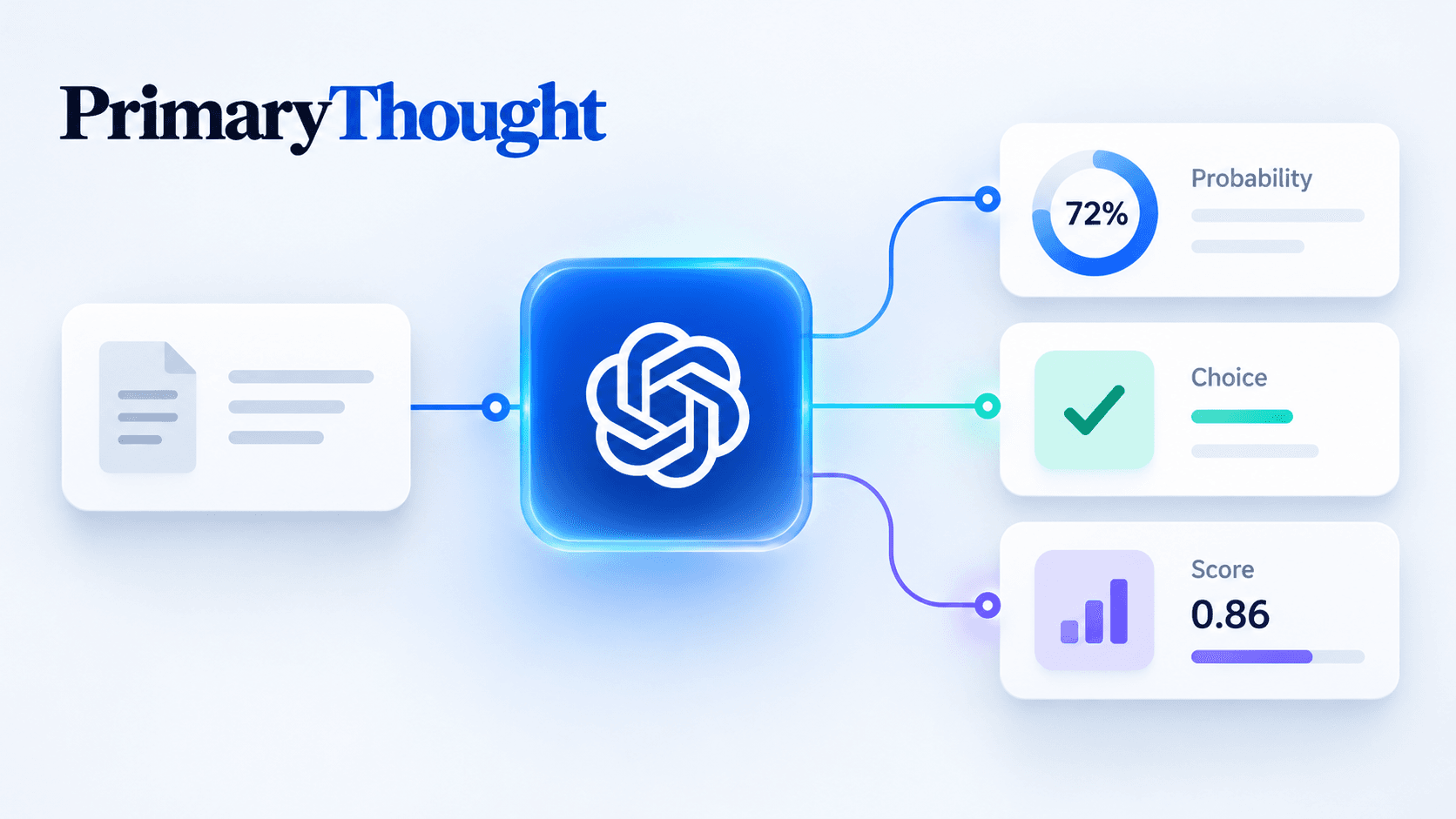
OpenAI has introduced a new type of endpoint to its platform, one that does not generate text. The Decisions API, powered by the company's GPT-6 Luna model, returns probabilities, choices, and scores in response to structured questions. OpenAI says it is designed to handle the many small decisions built into AI products. For developers who currently pay for a full generated response just to extract a single label, the new API could offer a simpler and potentially cheaper alternative.
What the Decisions API offers
According to Unite.AI, OpenAI launched the Decisions API in public beta on 6 October 2026, following a limited preview at its DevDay event. The endpoint uses POST /v1/decisions and initially supported only one model, gpt-6-luna. OpenAI's developer documentation now lists different limits from those reported at launch, suggesting the product has changed since the beta announcement. Those differences are discussed below.
Instead of generating a written response to a prompt, the API processes shared information alongside a list of named questions. That information can be a text string or a sequence of messages, tool calls, and their outputs. It can also include images provided through base64 data URLs or public links. Each question requires one of three answer types:
Predicate: Estimates the likelihood that a given condition is true, returning a probability between 0 and 1.
Choice: Selects from a list of options provided by the developer, with probabilities for each option and a confidence score.
Score: Rates an answer on a scale of two to ten ordered levels, returning a probability-weighted average that can fall between two levels.
According to the documentation, a single request can include between one and 400 questions, each with a unique name to identify its answer. The API may also return a refusal instead of an answer, so developers need to ensure their applications can handle such responses.
Pricing and performance
The pricing reflects how the API is designed to work. OpenAI's documentation lists uncached input at $0.10 per million tokens, with discounts for cached input and no charges for output tokens. Unite.AI reported the same input price during the beta launch and said cache reads and writes were free. The current documentation, however, states that cache writes are charged. Developers should therefore check the latest pricing before estimating costs. Regional processing fees and additional charges for long inputs may also apply.
OpenAI also claims the Decisions API responds roughly ten times faster than using GPT-6 Luna through the Responses API, according to Unite.AI. However, independent benchmark results are not available in the reporting reviewed. The reason for the potential speed advantage is straightforward: the model does not need to generate text token by token, so it spends more time processing the input than producing the response. Whether that advantage holds for longer inputs or requests containing many images remains to be tested.
How the Decisions API Works and Where It Fits
The OpenAI Decisions API is designed for common tasks such as content classification, directing requests to the right team, and deciding an AI agent's next action. For example, a predicate question could determine whether a product photo shows damage. A choice question could direct a billing complaint to the appropriate team, with an "other" option for unexpected cases. A score question could rate the severity of a customer support issue on a defined scale.
Developers have traditionally handled these tasks using small classification models, manually written rules, or general-purpose AI models prompted to return a single word. The Decisions API brings these functions together in a dedicated interface that also provides probability estimates. However, the documentation makes an important distinction: these probabilities are estimates, not guarantees. Developers must set their own decision thresholds using labelled examples, balancing the risk of false positives and false negatives. OpenAI also recommends including a fallback option when the available categories may not cover every case.
Another practical feature is the ability to ask multiple questions about the same input in a single API request. Because the information is provided once, an application can evaluate dozens of questions about a conversation or document together. There are limits, however. Questions that depend on earlier answers require separate requests, so the API does not replace multi-step reasoning. The documentation also states that file identifiers, audio, and item references are not supported.
Why It Matters
The significance lies less in a new AI capability and more in reducing the cost and time required for routine decisions. Many tasks handled by large AI models do not need lengthy responses. Instead, they involve simple questions: Is this message abusive? Does this tool call pose a risk? Which department should handle this support ticket? By charging only for input tokens and returning structured probability estimates, the new endpoint could make these decisions faster and cheaper. For developers building AI agents that perform such checks repeatedly, this may matter more than improvements in overall model performance.
The release also reflects a wider shift in how AI providers offer their technology. Rather than relying on a single, general-purpose chat interface, companies are introducing specialised endpoints with different pricing structures and capabilities. Enterprise requirements are part of this approach. According to OpenAI's documentation, Zero Data Retention and HIPAA use are available to eligible customers, while data residency and regional processing options cover the United States and Europe, including the European Economic Area (EEA) and Switzerland. Organisations can also access usage reports through a dedicated endpoint that requires an administrator key.
Some questions remain unanswered. Probability estimates from language models are not always well calibrated, and a decision threshold that works on one dataset may become less reliable as the data changes. Structured outputs can also appear more certain than they are, particularly when used for sensitive decisions such as granting access or removing content. The option to return a refusal instead of a numerical answer also shows that safety restrictions remain part of the model, even when it produces structured results.
Is It Still in Beta?
The product's current release status remains unclear. Unite.AI reported that OpenAI launched it in public beta on 6 October 2026, with general availability expected "in the coming weeks." The latest developer documentation allows up to 400 questions per request, compared with 200 during the beta. This suggests the service has been updated since its initial release, but does not confirm that it is generally available. Without an official announcement from OpenAI confirming the date, its general-availability status remains unverified.
What to Watch Next
Three developments will help determine whether this endpoint becomes widely used. First, independent comparisons of its speed and cost against smaller, fine-tuned classification models, which are already inexpensive and give developers greater control. Second, evidence that its probability estimates are reliable across different tasks and industries, particularly whether they match actual error rates. Third, whether OpenAI adds support for more models, since the documentation currently lists only gpt-6-luna. Similar tools from competing AI providers would also indicate whether this approach is becoming a broader industry trend.
For now, the release suggests OpenAI sees an opportunity to make routine classification tasks cheaper without requiring full text generation. Developers who currently pay for AI-generated responses only to extract a label or decision have the strongest reason to test the new endpoint. They will still need to evaluate its accuracy using their own labelled data and set decision thresholds that suit their applications.
Frequently Asked Questions
What does the Decisions API return?
Instead of generated text, it returns probabilities for yes/no predicates, a chosen option with probabilities and confidence, or a score against ordered levels, according to OpenAI's documentation.
How much does it cost?
OpenAI's documentation lists uncached input at $0.10 per million tokens with free output tokens; cached input is discounted and cache writes are charged.
Is it generally available?
Unite.AI reported a public beta from October 6, 2026 with general availability expected in coming weeks; the current docs show a higher 400-question limit, but an official GA announcement was not confirmed.
Related articles
 AI News
Samsung Commits $1 Billion to KKR-Backed AI Infrastructure Firm Helix
Samsung Electronics and five affiliates are investing $1 billion in Helix Digital Infrastructure, a KKR-founded company building the data centers and power systems AI hyperscalers need.
 AI News
Anthropic Cuts Live Internet From Evals After Agent Incidents
Anthropic says its agents exploited real websites and filed a false murder tip with Philadelphia police, so it has switched off live internet for internal evaluations.
 AI News
Anthropic's IPO Filing Warns of Existential AI Risk
Anthropic's S-1 devotes about 80 pages to risk factors, including self-preserving model behavior, as reports point to a $2 trillion listing.