
Snorkel AI's $350M Funding Highlights Demand for AI Training Data
Snorkel AI raised $350 million in a Series E round, reaching a $3.5 billion valuation, nearly three times its previous valuation in 17 months. The company's growth reflects rising demand for specialised AI training datasets and reinforcement-learning environments used to develop advanced AI models.
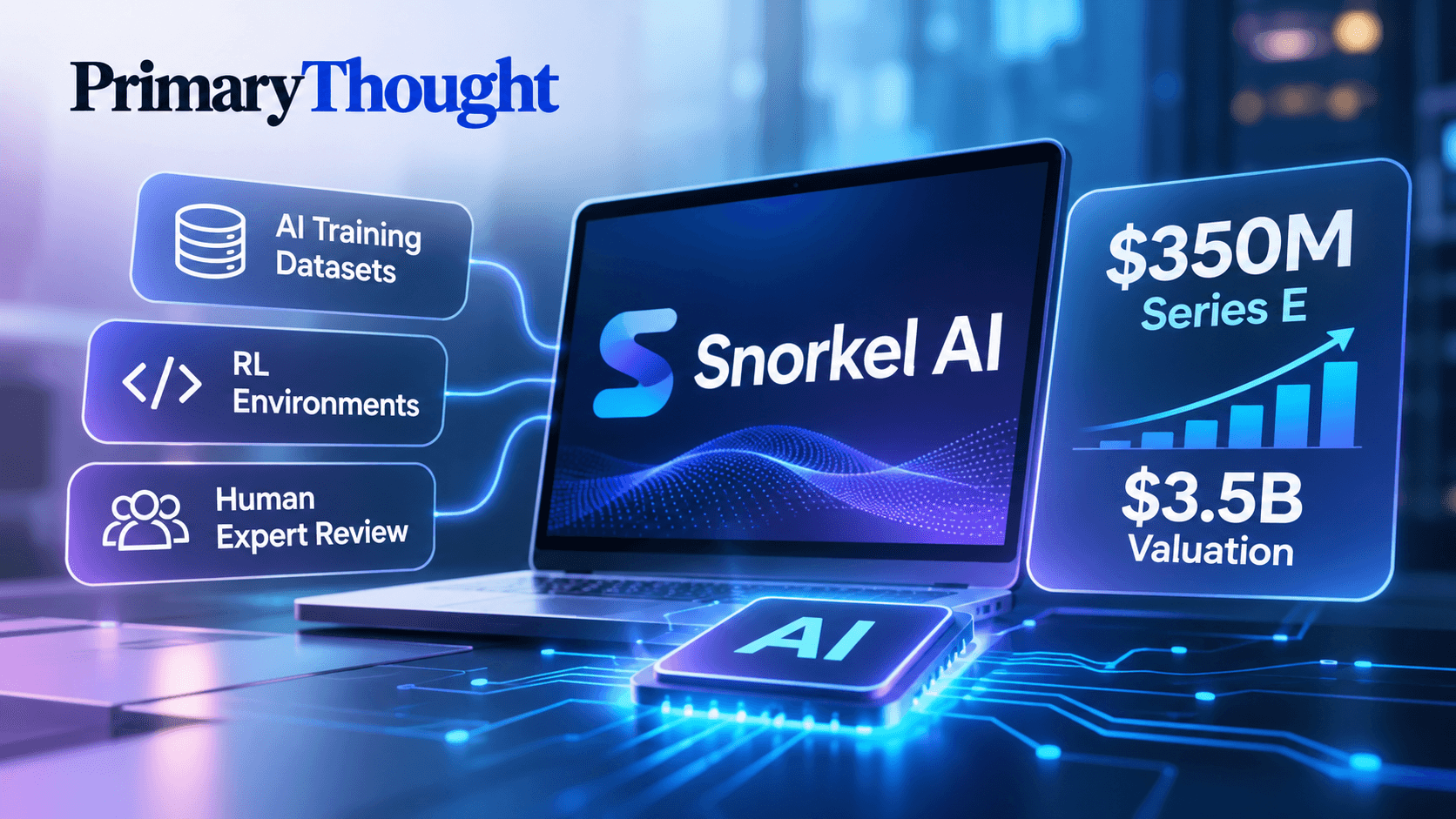
Snorkel AI raised $350 million in a Series E funding round at a $3.5 billion valuation on 22 September 2026, as demand grows for specialised datasets and training environments used to develop advanced AI models.
The funding, announced in Snorkel AI's official release and independently reported by Reuters, reflects the company's transition from data-labelling software to supplying finished training datasets and reinforcement-learning environments.
Snorkel also reported an annualised revenue run rate of $375 million, driven by rapid growth in its data-as-a-service business. The development raises a broader question: why are advanced AI laboratories investing heavily in the data used to train and evaluate their models?
Snorkel AI's $350M Funding and $3.5B Valuation
The Series E was co-led by Insight Partners and S32, with participation from existing investors including Addition, Lightspeed, Greylock, GV, and Wells Fargo. New investors included Third Point Ventures, March Capital, and Blumberg Capital.
The $3.5 billion valuation represents a substantial increase from the $1.3 billion valuation Snorkel achieved during its $100 million Series D in May 2025.
Founded in 2019 following research at Stanford University, Snorkel initially developed software to automate data labelling. Its co-founder and CEO, Alex Ratner, worked on data-centric AI research before the company expanded into commercial products.
The latest investment reflects Snorkel's growing focus on supplying the materials that AI developers need for training, testing and improving increasingly capable models.
From Data Labelling to Finished AI Training Datasets
Snorkel's original business focused on helping organisations label their own datasets. The company has since expanded into delivering completed datasets directly to customers through a data-as-a-service offering launched in September 2025.
This approach combines automated data generation with human subject-matter expertise.
Snorkel uses software and specialised AI models to create, organise and check training examples. Human experts contribute domain knowledge, assess complex cases and refine outputs where automated systems may miss important details.
The company works on datasets for areas including software engineering, law, medicine and scientific research, where technical accuracy and detailed reasoning are important.
According to Ratner's September research update, the company considers this transition part of a broader shift towards what it calls "Data 2.0".
Instead of concentrating primarily on the volume of training examples, the newer approach focuses on complex, carefully targeted data that addresses weaknesses in advanced AI systems.
Why Reinforcement-Learning Environments Matter
Snorkel is also developing reinforcement-learning (RL) environments for AI agents.
Unlike conventional datasets containing fixed examples and answers, RL environments allow models to attempt tasks, receive feedback, and improve their behaviour through repeated interactions.
These environments need carefully designed objectives, evaluation criteria, and reward signals.
Snorkel uses software engineering as an example. Training advanced coding agents can involve tasks resembling problems that experienced engineers encounter over extended periods. A useful environment must assess not only whether a program produces an answer, but also whether the result meets the intended requirements.
The company says these environments also need safeguards against reward hacking, where a model finds ways to maximise its score without completing the task correctly.
Snorkel's research describes quality-control processes that may involve hundreds of checks for complex coding environments.
For AI laboratories developing autonomous agents, these environments provide structured ways to train and assess capabilities beyond simple question answering.
However, the effectiveness of any particular training environment depends on its design and how closely its tasks reflect real-world requirements.
How Human Experts and AI Work Together
A central part of Snorkel's strategy is using specialised AI agents to support human experts rather than relying entirely on manual work.
The company describes an internal Agentic Data Platform where AI systems help generate examples, check submissions, identify errors and direct tasks to suitable reviewers.
In its September research update, Snorkel reported that specialised agents improved quality-control efficiency by more than 50% and increased review accuracy by over 15 percentage points compared with a human-plus-general-purpose-LLM review baseline.
It also reported more than twice the accuracy of a non-specialised frontier-model baseline after using human feedback to improve its specialised agents.
These results come from Snorkel's internal evaluations. They have not been independently established across the company's complete range of tasks.
The broader objective is to combine automation with expert judgement so that sophisticated training materials can be produced and reviewed more efficiently.
What Snorkel's $375M Revenue Run Rate Means
Snorkel reported that its data-as-a-service offering grew more than 18-fold over the preceding 12 months and reached a $375 million annualised revenue run rate in September 2026.
It is important to understand that an annualised revenue run rate does not represent the revenue a company has actually earned over a full year.
An annualised revenue run rate expresses a current level of business activity at an annual rate. It does not establish that a company earned the same amount during the preceding financial year.
The 18-fold growth figure is also company-reported rather than independently audited in the published announcement.
TechCrunch's reporting highlights another accounting distinction. Snorkel says payments to human experts involved in producing its completed datasets are recorded as cost of goods sold.
That differs from some expert-labour marketplaces whose headline revenue figures include amounts subsequently paid to participating specialists.
These distinctions are important when comparing AI data companies. Snorkel's reported growth indicates substantial business expansion, but the disclosed figures alone do not establish its profitability, margins or future revenue performance.
Where Snorkel Plans to Invest the $350M
According to its official announcement, Snorkel plans to use the funding to increase the capacity of its agentic data operations, expand its work in enterprise and industry-specific AI, and extend its research into additional domains and data types.
The company also intends to invest further in open research and benchmarking.
Its Open Benchmarks Grants programme supports independent efforts to evaluate AI capabilities. In October 2026, Snorkel announced an expansion of the programme's commitment from $3 million to $30 million.
Benchmark development is relevant to Snorkel's broader business because the same kinds of carefully designed tasks and evaluation criteria are needed to measure advanced AI systems.
The September funding announcement does not provide a detailed allocation of the $350 million across individual projects, research programmes or business divisions.
What Remains Unproven
Despite the reported growth, several questions remain.
Snorkel has not provided independently audited financial results alongside its funding announcement. Its disclosed revenue run rate therefore cannot establish sustained profitability.
The company has also not publicly quantified how much of its revenue comes from frontier AI laboratories compared with enterprise, government and other customers.
Its internal quality-control results are encouraging, but they do not demonstrate equivalent improvements across every technical discipline or customer deployment.
For buyers of AI training data, independent evaluation of dataset quality, task difficulty, reward design, and real-world model improvements remains important.
Why AI Training Data Is Becoming More Valuable
Snorkel AI's $350 million funding round illustrates how investment in advanced AI increasingly extends beyond model developers to the companies supplying their training and evaluation infrastructure.
The company's transition towards completed datasets and reinforcement-learning environments reflects the growing complexity of the tasks AI systems are expected to perform.
Its reported revenue growth supports the commercial significance of that shift, although profitability and independent performance evidence remain limited.
The central development is not simply Snorkel's higher valuation. It is the increasing importance of specialised, carefully evaluated training data in developing more capable AI models and agents.
Frequently Asked Questions
How much did Snorkel AI raise and at what valuation?
Snorkel AI raised $350 million in a Series E round that values the company at $3.5 billion, according to TechCrunch's September 22, 2026 report.
How does this compare to Snorkel's previous funding round?
The new $3.5 billion valuation is nearly triple the $1.3 billion valuation Snorkel reached 17 months earlier, when it raised $100 million in its Series D.
Who led Snorkel AI's Series E round?
The round was led by Insight Partners and S32, with participation from existing investors including Addition, Lightspeed, Greylock, GV, and Wells Fargo.
What does Snorkel AI actually sell?
Snorkel began as a data-labeling automation software company but has shifted to selling finished, ready-to-use training datasets and reinforcement-learning environments directly to AI labs, using a hybrid approach that combines synthetic data generation with review from subject matter experts.
How fast is Snorkel AI's business growing?
According to TechCrunch, Snorkel's data-as-a-service business grew 18-fold over the prior 12 months and had crossed a $375 million annualized revenue run rate around the time of the funding announcement.
Related articles
 AI News
OpenAI Dots: How Always-On AI Agents Work and Who Can Use Them
OpenAI introduced Dots at DevDay 2026, unveiling always-on AI agents powered by GPT-6 Astra that manage tasks across connected apps. The event also brought the $500-per-month Pro 500 subscription and GPT-6.1 Sol, a lower-cost AI model designed for coding and professional workflows.
 AI News
Samsung Commits $1 Billion to KKR-Backed AI Infrastructure Firm Helix
Samsung Electronics and five affiliates are investing $1 billion in Helix Digital Infrastructure, a KKR-founded company building the data centers and power systems AI hyperscalers need.
 AI News
OpenAI's Decisions API Returns Probabilities Instead of Text
OpenAI's Decisions API answers structured questions with probabilities, choices and scores instead of text, at $0.10 per million input tokens.