
Yelp's New AI Agent Calls Restaurants to Check Wait Times
Yelp's new Check for Me feature uses an AI voice agent to call restaurants and text users their wait times. The update also brings OpenTable bookings, saved preferences and lists to the Yelp app.
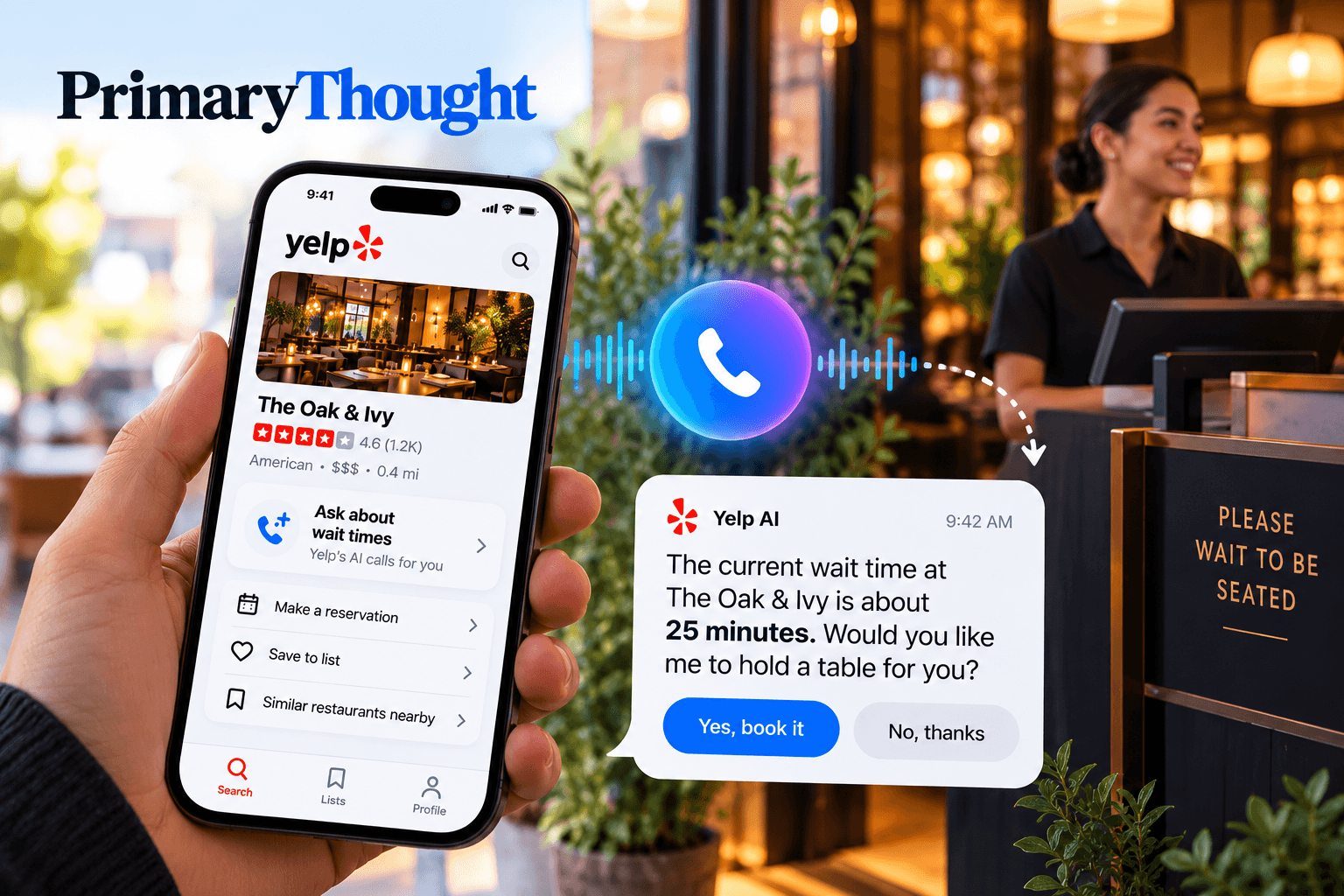
Yelp has added an AI voice agent that phones a restaurant on your behalf to ask how long the wait is, then texts you the answer. The feature, called Check for Me, was reported by TechCrunch on October 20, 2026, and it matters because it puts an automated caller on the consumer side of a phone line that Yelp already sells automated answering tools for.
It arrives with a wider set of updates to Yelp's AI assistant: restaurant booking through OpenTable, saved preferences, chat history and a new lists feature. Taken together, they show how a local-search company is trying to turn a directory into an assistant that acts, not just answers.
What Check for Me does
According to TechCrunch's report, the option appears on restaurant pages in the Yelp app. A user enters a party size and a phone number. An AI voice agent then calls the restaurant, asks about the current wait, and sends the result by text message so the user can decide whether to go.
TechCrunch places the feature in a run of consumer assistants that can phone businesses for customer-support questions or appointments, naming Instinct, Fo and Muse. Yelp is the latest established consumer brand to follow. The same article raises an obvious wrinkle: the restaurant that picks up may itself be answered by an AI agent, so two automated systems could end up talking to each other, and the report notes that such an exchange might break down.
That scenario is not hypothetical, because Yelp sells the other half. Yelp Host, its AI call-answering product for restaurants, launched on October 21, 2025. Industry site PPC Land summarised Yelp's July 2026 update, saying the product had handled more than 1 million calls since launch, with monthly volume growing 38% on average through June. Those are Yelp's figures as relayed by that outlet, and the same report notes that Yelp did not say how many restaurants use the product or how many calls ended in a booking or order.
The other changes in the release
The wait-time caller is one piece of a larger update to the Yelp assistant. Based on TechCrunch's account, the changes include:
- OpenTable integration: users can book a table without leaving the Yelp app.
- Memory: the assistant remembers preferences mentioned in earlier conversations.
- Chat history: the last 30 days of chats are available, with full history described as coming soon.
- Reminders: users can ask for recurring prompts, for example weekend activity suggestions every Friday.
- Lists: two lists, "Been Here" and "Want to Go," that can be filtered by location, category and cuisine, reordered, annotated and shared.
According to the report, weekly personalised recommendations based on saved items and rankings will start in November 2026, and later in the year it plans to convert existing collections into lists, redesign the lists tab and add a map view. None of those later items has shipped, so they should be read as plans.
A paid tool for businesses
The release also includes a business-facing product. TechCrunch describes Smart Lead Reply as an agent that responds to customers and engages them to qualify leads, priced at $30 a month. Owners can define how the agent should handle conversations. The article notes that Meta is pursuing the same small-business market with AI tools for inbound customer inquiries.
The pricing contrast with Yelp Host is useful context. Per PPC Land's summary of the July update, Yelp Host costs $249 a month, or $199 for customers of Yelp Guest Manager. A $30 lead tool is a far lighter commitment, which suggests Yelp is trying to put AI into more of the products that small businesses already buy from it.
Why it matters
For users, the appeal is narrow but real. Checking a wait time is a task people often do by phone, and it is easy to describe and to verify: either the text message arrives with a plausible number or it does not. A tightly scoped task like this is a more credible use of a voice agent than an open-ended request to run an errand.
For Yelp, the strategic logic runs through its revenue mix. The PPC Land article reports that Yelp's restaurant, retail and other advertising revenue fell 6% in 2025 to $444 million, while its "other" revenue, which includes transactions and software, rose 75% to a record $29 million in the first quarter of 2026. The company has set a target of $250 million in annual run-rate other revenue by the end of 2028, with Yelp Host named as one driver. Consumer features that generate calls and bookings feed that story, though Yelp has not said how Check for Me contributes.
For restaurants, the feature adds a new kind of inbound call. A restaurant that already uses an AI answering service may handle these calls without staff noticing, while one that relies on a host stand may find a steady trickle of automated callers interrupting service. TechCrunch's report does not say whether restaurants can opt out or how callers identify themselves, and those details will matter for adoption.
Open questions and what to watch
Several things remain unclear from the sources reviewed. Yelp has not, in the coverage opened here, published accuracy figures for the wait-time calls, and it is not stated how the agent behaves when a restaurant does not answer, quotes a range, or declines to speak to an automated caller. Disclosure is another open point: whether the agent tells the restaurant it is an AI, and whether any rules or platform policies require it.
Three developments are worth tracking. First, whether Yelp extends the calling feature beyond wait times to reservations or availability checks, which would overlap with its OpenTable link. Second, how restaurants using Yelp Host or competing answering services respond to automated callers. Third, whether the November recommendation emails and the lists redesign deepen use of the assistant or simply add surface area.
The broader lesson is about direction. Voice agents are moving from the business side of the counter to the customer side, and platforms that sit on both ends of a call gain unusual visibility into how those conversations go. Whether users trust an assistant to phone on their behalf, and whether businesses tolerate it, will be decided by small reliability details more than by the headline feature.
Frequently Asked Questions
What is Yelp's Check for Me feature?
Per TechCrunch, users enter a party size and phone number on a restaurant page in the Yelp app, and an AI voice agent calls the restaurant to ask about the wait and texts back the result.
What else did Yelp add to its assistant?
OpenTable booking, memory of preferences, 30 days of chat history, custom reminders, and 'Been Here' and 'Want to Go' lists, according to TechCrunch.
What is Smart Lead Reply?
A paid business tool that responds to customers and qualifies leads, priced at $30 a month according to TechCrunch.
Is Yelp's calling feature proven to be accurate?
The sources reviewed give no accuracy figures for wait-time calls, so reliability is not yet independently established.