
Eka Robotics Raises $150M to Bring Force-Sensing AI to Factories
Eka Robotics reportedly raised $150M at a $1.45B valuation to develop force-sensing robots for factory picking and wire handling. Its performance claims remain independently unverified.
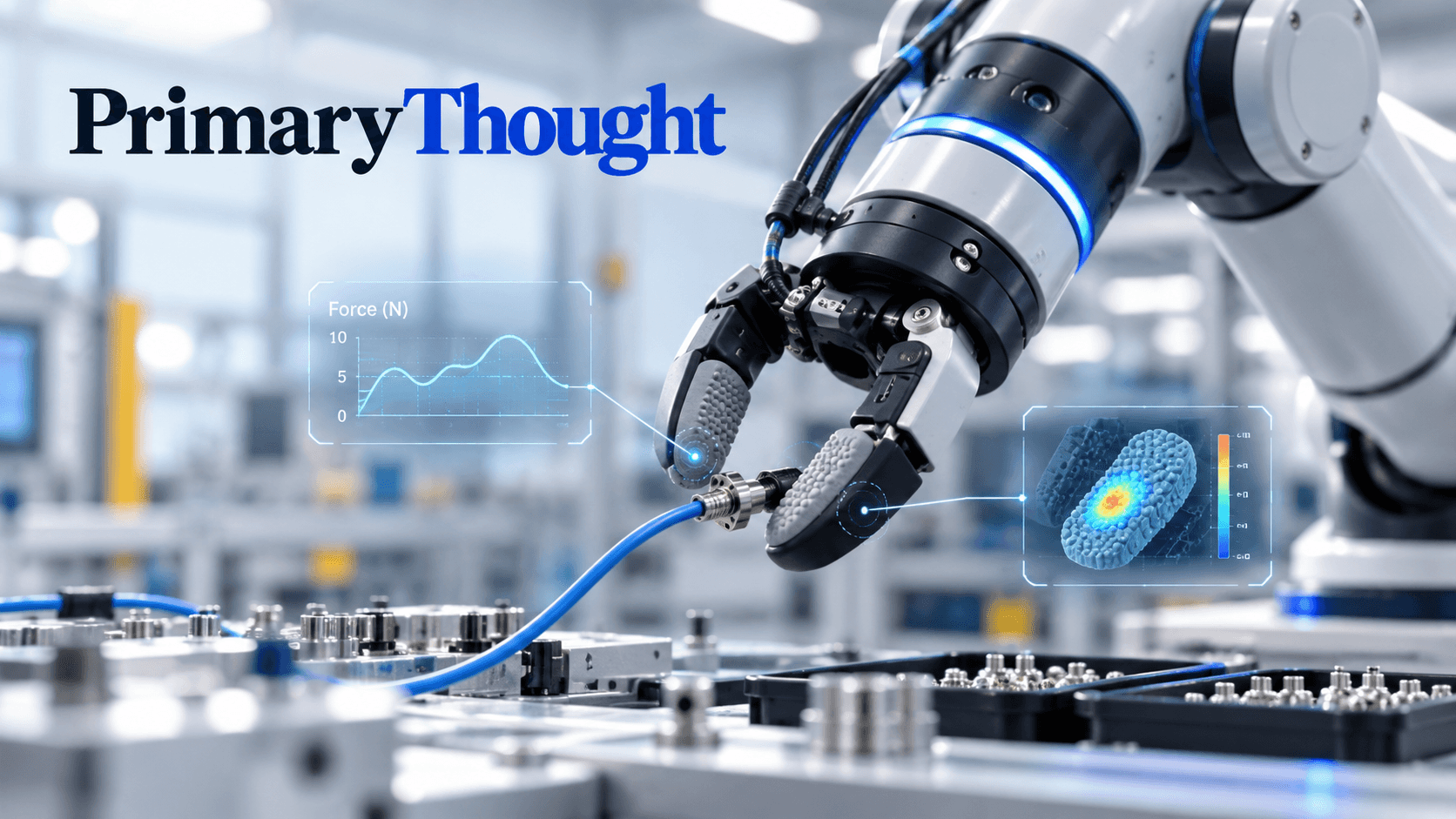
Eka Robotics has raised $150 million in Series A funding, valuing the startup at $1.45 billion. According to TechCrunch, which reported the deal on 20 October 2026, the company is developing AI-powered robotic hands that use force feedback to handle objects. Unlike systems that rely mainly on visual information, Eka's model uses touch and pressure to guide movement. Its first industrial targets include picking, placing and arranging parts, along with wire handling.
The technology has attracted major investment, but its performance outside controlled demonstrations remains an open question. For manufacturers, the real test will be whether Eka's robots can work reliably on production lines over long periods.
What Eka Says It Has Built
Eka, based in Cambridge, Massachusetts, was founded by MIT professor Pulkit Agrawal and former Google DeepMind researcher Tuomas Haarnoja. Humanoids Daily reported on the startup's emergence from stealth in April 2026. The company has developed a Vision-Force-Action model that it says helps robots understand mass, inertia and friction. Unlike vision-language-action models, Eka's approach focuses on force rather than language, which the company argues cannot fully capture how robots interact with physical objects.
Eka has also developed a custom gripper fitted with additional force sensors. According to TechCrunch, these sensors help robots adjust their grip when touching objects, such as handling a raspberry without crushing it. Agrawal explains that vision helps a robot locate an object, while force controls the "last millimeter" of grasping.
The Performance Numbers and Their Sources
TechCrunch cites figures from Eka showing that its system can pick around 1,500 objects per hour, compared with about 600 for a human. It can handle objects weighing up to one kilogram and reportedly achieves a grasping success rate of over 95%. Kris Hauser, a professor at the University of Illinois, told TechCrunch that the system can handle different objects without retraining. Raghu Raguram, a partner at a16z, said the technology already outperforms humans on certain tasks and expects more examples within months. These figures and predictions come from Eka and its investor, not independent benchmark testing.
TechCrunch also reports that Eka's gripper costs less than $1,000 and is rated for five million duty cycles. The company aims to reach 20 million cycles, which the article identifies as the standard for industrial robotic arms. Durability matters in factories because frequent equipment failures can lead to costly downtime, reducing the savings from automation.
A Different Training Approach
Eka takes a different approach to training robots by using simulation. Humanoids Daily reports that the company relies on realistic simulations and touch-sensitive grippers rather than copying human movements. Eka claims its algorithms help robots apply what they learn in simulations to real-world tasks. This differs from competitors that collect hundreds of thousands of hours of real-world training data using gloves worn by humans. The report groups robotics companies into three categories: those that imitate humans, those that use reinforcement learning on physical robots, and those that train in simulations, including Eka.
TechCrunch reports that Eka uses reinforcement learning in a physics simulator to train robots at scale. The company says it can generate thousands of hours of robot experience in minutes but has not shared details of its methods. Humanoids Daily also notes that Eka draws inspiration from DeepMind's AlphaZero, aiming to develop robots that can outperform humans rather than simply copy their actions.
What Is Still Unproven
Eka's long-term performance in factories remains untested. TechCrunch reports that the company is running pilots with unnamed industrial customers on pick-and-place tasks and wire handling. Customer names, deployment timelines and production volumes have not been disclosed. Humanoids Daily's April report also provides no funding figures or customer names.
Kris Hauser, quoted by TechCrunch, described Eka's demonstration as having a "wow factor" but said the real test would be running on assembly lines for a full year without failure. He also questioned whether the technology could handle more complex industrial tasks. It remains unclear how well simulation results will translate to large-scale production. An unnamed roboticist at a leading AI lab compared Eka's progress to advances in robotic walking five to ten years ago, though this was an opinion rather than a measured comparison.
TechCrunch also notes that researchers, including Rodney Brooks, have long argued that robots need to understand force and touch alongside vision. Eka's reported results support this approach, but its effectiveness in real-world manufacturing still needs to be demonstrated.
Why It Matters for Manufacturing
Pick-and-place tasks and wire handling may seem simple, but they are valuable in manufacturing. Cable and harness assembly remains difficult to automate because wires are flexible and vary in shape, leaving many factories dependent on manual labour. Robots that can sense contact and adjust their grip after slipping could make more tasks suitable for automation. Eka's gripper reportedly costs less than $1,000, but integration, safety and maintenance are also important expenses that the available reports do not address.
Eka's funding reflects a wider trend in physical AI, where startups attract major investment based on promising demonstrations before proving long-term performance in factories. Its $1.45 billion valuation shows how high investor expectations are, despite limited publicly disclosed commercial results.
What to Watch Next
Three developments will help show whether Eka's technology can succeed beyond demonstrations. First, the company needs to name customers and show how long its robots have operated on production lines. Hauser's suggested one-year test would be a useful measure of reliability. Second, independent testing should confirm throughput and failure rates, including on tasks not selected by Eka. Third, the company needs to show whether its force-based approach works beyond picking, placing and wire handling, particularly in more complex assembly tasks.
For now, Eka remains a well-funded robotics startup with promising technology, but its main manufacturing claims still need independent verification.
Frequently Asked Questions
What is Eka building?
A vision-force-action robot model plus a sensor-rich gripper that uses force and touch to handle objects, according to TechCrunch and Humanoids Daily.
What performance does Eka claim?
About 1,500 object picks per hour versus roughly 600 for a human, with over 95% reliability, per TechCrunch citing Eka. These are company claims.
Is it deployed in factories?
Eka is running pilots with unnamed industrial customers on pick-and-place and wire handling; no customers or volumes have been disclosed.
What is the main open question?
Whether it can run on real assembly lines for a full year and generalize beyond pick-and-place, as UIUC professor Kris Hauser notes.