
Connecticut: AI Tools No Longer a Defence in Bias Claims
Since October 1, Connecticut employers cannot cite automated decision tools as a defence to discrimination claims. Notice duties follow in 2027.
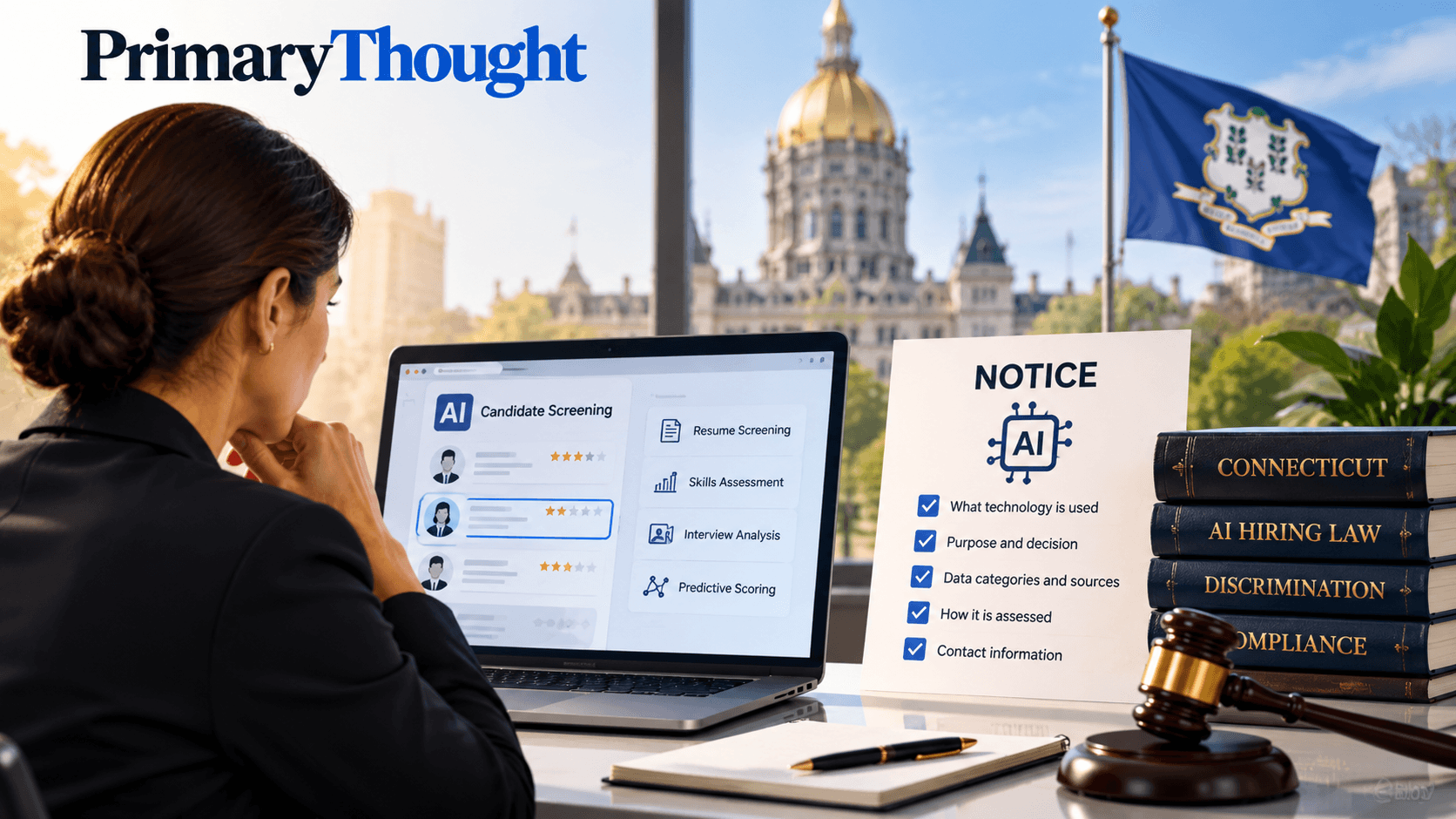
Connecticut employers can no longer use AI hiring tools as a defence against claims of employment discrimination. Since 1 October 2026, Public Act 26-15, "An Act Concerning Online Safety," has made it clear that using an automated employment-decision tool does not protect employers from claims under the state's fair employment law. For HR teams, this means they remain responsible for decisions made using third-party screening tools. The main requirements to notify applicants and employees will take effect a year later.
What the Law Does and When
According to an analysis published on mvalaw.com, Governor Ned Lamont signed the law on 27 May 2026. The employment discrimination changes took effect on 1 October 2026. Under these rules, employers cannot use automated hiring tools as a defence against unlawful discrimination claims. A FordHarrison summary confirms the same signing and effective dates.
The notice requirements have a different timeline. The mvalaw.com analysis explains that the rules for developers and users of these tools formally took effect on 1 October 2026, but apply only to covered tools deployed on or after 1 October 2027. FordHarrison states more simply that employer disclosure requirements begin in October 2027. Both accounts point to the same practical deadline: employers have about a year to prepare for the new notice requirements.
Which Tools Are Covered
According to FordHarrison, the law covers technology that processes personal data and produces scores, rankings or predictions that play a major role in employment decisions. The mvalaw.com analysis lists examples such as resume screening, computer-based assessments, predictive testing, targeted job advertising and interview analysis. It also covers systems that assess third-party data about applicants or employees. Everyday software, including word processors, spreadsheets and data storage tools, is excluded.
The law applies to a wide range of employment decisions. FordHarrison lists hiring, firing, promotions, disciplinary action, training or apprenticeship selection, tenure, contract renewal and other employment conditions. Some activities are excluded, including minor workplace changes, health and safety decisions, scheduling, planning and productivity monitoring. The Connecticut law covers more employment decisions than New York City's Local Law 144, which focuses on hiring, promotion and screening. Still, Connecticut's exemptions mean some workplace management tools fall outside its scope.
What Employers and Vendors Must Do
From October 2027, employers must inform applicants or employees when they interact directly with an automated tool, unless its use is already clear. Before making an employment decision, employers must also provide written notice explaining:
The technology being used and its trade name.
Its purpose and the employment decision it affects.
The types of personal data it uses and how they are assessed.
Where the data comes from.
The employer's contact information.
Employers can withhold trade secrets or legally protected information, but must explain what is being withheld and why. Vendors that market, sell, license or configure these tools must provide the information employers need to meet these requirements.
The mvalaw.com analysis also notes that employers can assign certain disclosure duties to developers through a contract, provided it clearly states their responsibilities. Some requirements may also affect employers outside Connecticut if their tools interact with applicants or employees based in the state, including remote workers.
A Lighter Approach to Bias Testing
Unlike New York City's law, Connecticut does not require employers to conduct bias audits before using automated hiring tools. Bias testing is voluntary under the law, although courts or commissions may consider the results as evidence. A Department of Consumer Protection pilot programme for independent verification organisations will begin on 1 July 2027, with up to five organisations approved. Evidence from the pilot can be used only in private civil cases involving personal injury or property damage, not in enforcement actions brought by the Attorney General or other agencies.
The analysis also examines Mobley v. Workday. On 29 May 2026, a magistrate judge ruled that Workday's bias-testing data was legally privileged because lawyers had selected and used it to provide legal advice. This does not mean all bias-testing data is protected. It raises a practical question: how can employers use testing to show they have taken precautions if the results are protected by legal privilege?
Connecticut's approach is similar to Colorado's amended rules, which focus on notices, explanations, data correction rights and human review rather than mandatory bias testing. The analysis also highlights similarities with California's automated decision-making rules.
Enforcement Is Limited, but the Defence Rule Still Applies
Only Connecticut's Attorney General can enforce the notice and disclosure requirements under the state's unfair trade practices law. Individuals cannot bring private lawsuits for violations of these requirements. For violations before 31 December 2027, the Attorney General must first issue a notice and allow 60 days to correct the problem. According to FordHarrison, penalties can reach $5,000 per violation or $25,000 for violating an injunction under the Connecticut Unfair Trade Practices Act, although remedies are generally equitable.
The rule on discrimination claims works differently. It forms part of Connecticut's fair employment law and applies when employers face discrimination claims. The reviewed sources do not identify any cases where courts have applied the new rule. Its practical impact will become clearer as employees bring claims and courts interpret the law.
What HR Teams Should Do Now
FordHarrison recommends several steps to help employers prepare. First, review existing HR tools to identify those covered by the law, including features within larger platforms that score or rank applicants and employees. Next, ask vendors for the information needed to prepare notices and check contracts to clarify who is responsible for each requirement. Employers should also establish procedures to ensure applicants and employees receive the required notices. Starting early is important because the work involves recruitment, HR operations and legal teams.
The change introduced on 1 October 2026 also makes it important to review how automated tools are tested and monitored for discrimination. Although bias testing is not mandatory, employers may benefit from keeping records of how they assess potential discriminatory effects. Whether those records help or create legal risks in a lawsuit may depend on how legal privilege applies, an issue highlighted by the Workday ruling.
What to Watch Next
Three dates are important: 1 July 2027, when the verification pilot begins; 1 October 2027, when the notice requirements start; and 31 December 2027, when the initial 60-day cure-period provision ends. Several questions remain, including how regulators will handle automated tools built into larger HR platforms, how vendors will share information without exposing trade secrets, and whether other states will adopt similar rules that focus on notice requirements.
Frequently Asked Questions
What changed on October 1, 2026?
Connecticut employers can no longer use automated employment-decision technology as a defence to an unlawful discrimination claim.
When must employers give notice?
Notice and disclosure duties begin October 1, 2027, including written pre-decision notice about the tool's purpose, data and sources.
Is a bias audit required?
No. The act does not require a pre-use bias audit, unlike New York City's rule; bias testing is voluntary.
Who enforces the notice rules?
Only the Attorney General, as an unfair trade practice. There is no private right of action for those provisions.
Related articles
 Workforce & HR AI
California's No Robo Bosses Act: What HR Teams Must Know
California's SB 947, signed September 30, requires human corroboration when automated systems drive discipline or firing, effective July 1, 2027.